


1 out of 3 jobs in crypto marketing today is looking for an institutional marketer – someone who understands how institutions buy infrastructure, and can build a demand generation pipeline, not just create content.
At the moment, job searching may not be easy for marketers fond of engineering hype because it is totally the opposite of what appeals to institutions.
Crypto founders used to anonymity and paid PRs are struggling to use LinkedIn as thought leaders – which is a necessary requirement for building credibility with institutional buyers.
So I pulled out 24 institutional crypto marketing job descriptions at companies like Fireblocks, Chainlink, Ondo Finance, and Anchorage Digital, analysed the data and created something you’ll find absolutely valuable – The Crypto Institutional Marketing Playbook.
This playbook shows exactly how to market crypto products to banks, asset managers, hedge funds, and other institutional key players.
Inside the playbook : 19 chapters that cover : what institutional marketing is, how it is different from B2C crypto marketing, what content to create, how institutions buy infrastructure, which buyers to target, how to prove that your marketing drives pipeline, a practical demand generation checklist for whatever buyer persona you are targeting, a quiz at the end to test your knowledge AND LOTS MORE!
The gems in this playbook are inexhaustible but this article tries to compress the booklet and give you a quick glance of what you have inside.
Table of contents
What does the data say?
What is crypto institutional marketing?
Who are institutions in crypto?
How is institutional marketing different from retail crypto marketing?
Why is crypto institutional marketing suddenly in demand?
How do crypto companies attract institutions?
What skills do crypto institutional marketers need?
Messaging – How to talk to institutions
7 common mistakes in crypto institutional marketing
Practical: Create your demand generation pipeline and test yourself
Ice breaker
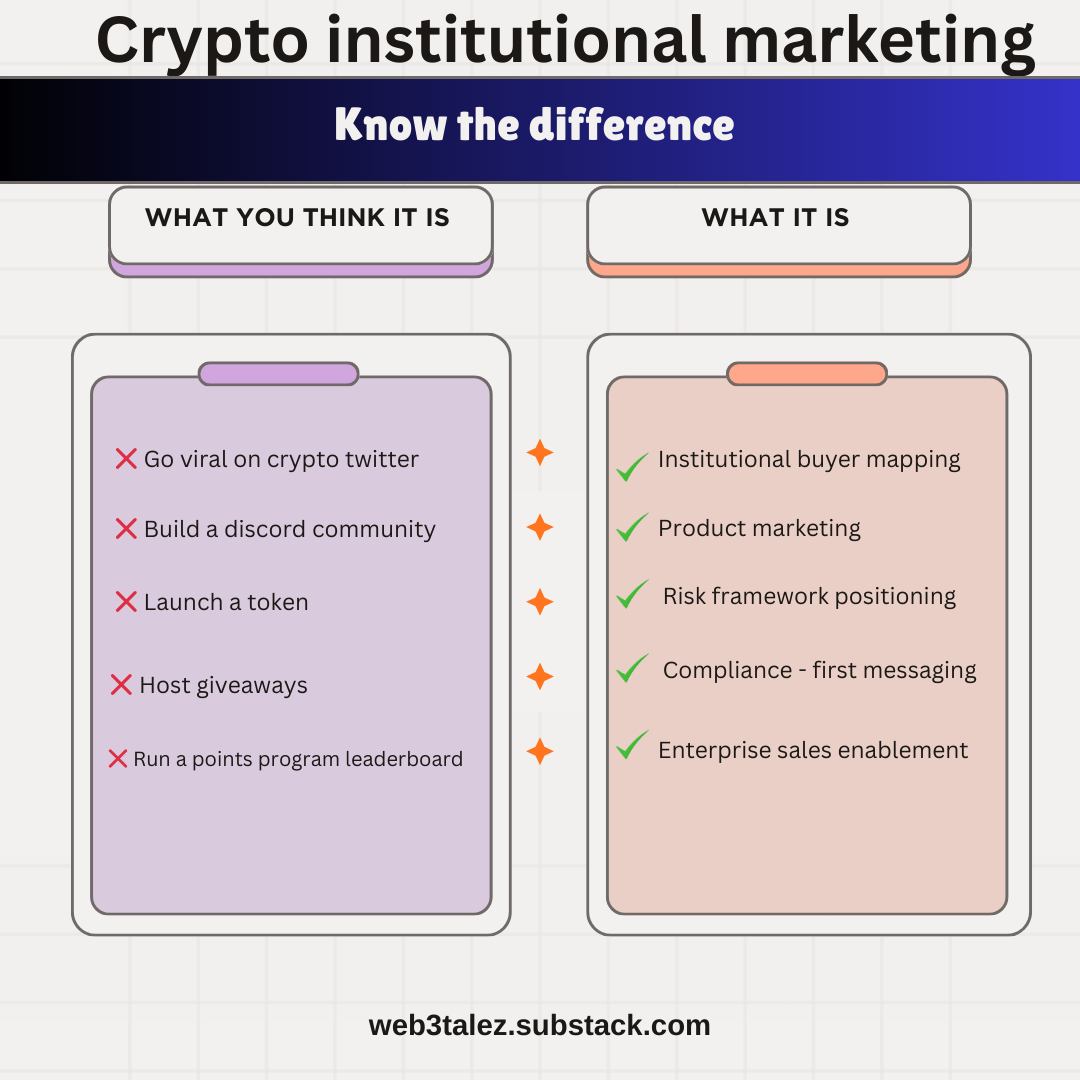
Crypto institutional marketing is entirely different from the crypto marketing tactics you already know, like creating a community, incentivising users, launching a token, posting on Twitter. This one requires more structure, tooling and the ability to track every single effort.
What does the data say?
As a popular quote says: “if you torture the data long enough it will confess.”
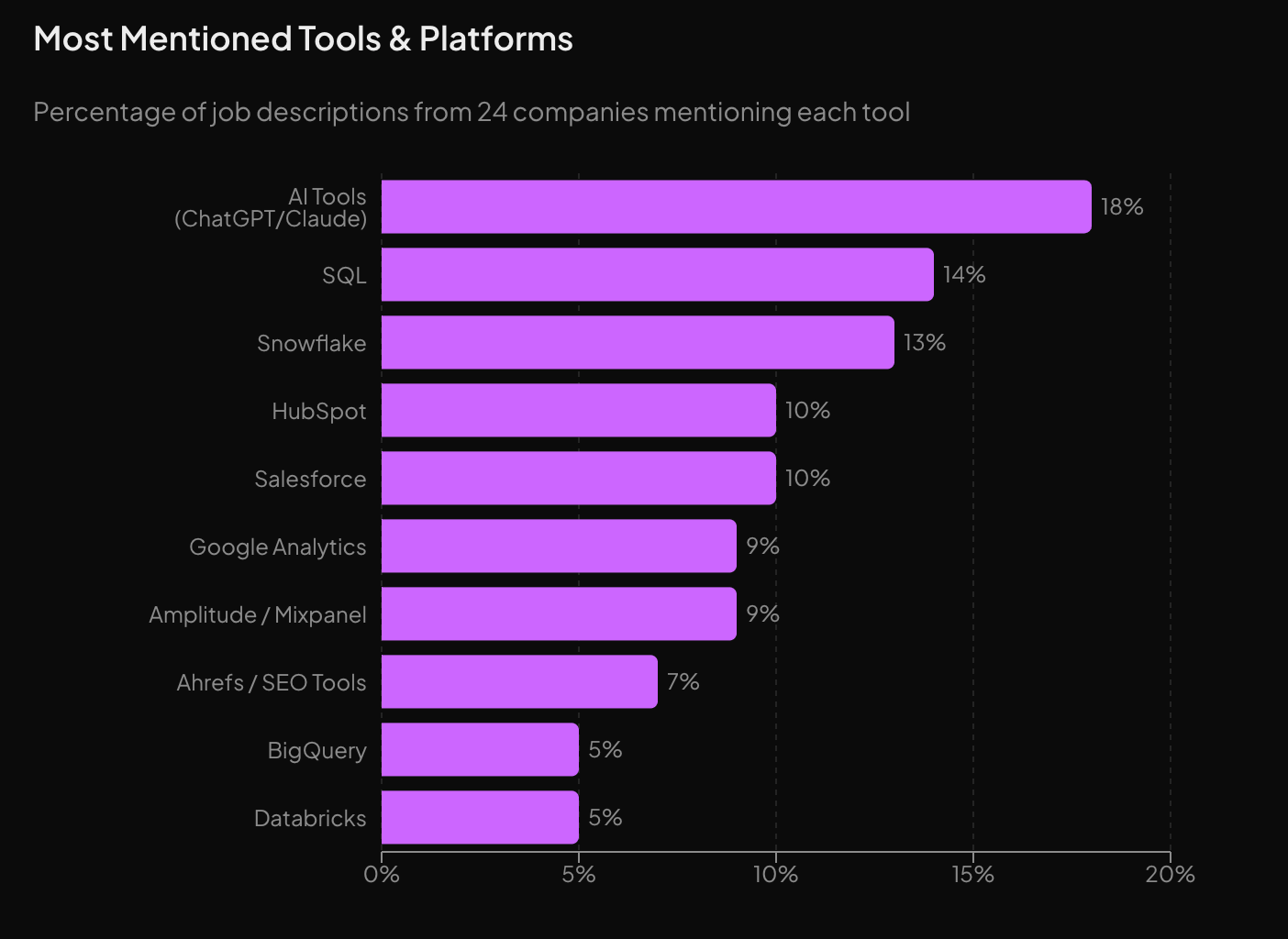
Well, after torturing the data of 24 crypto institutional marketing job descriptions here’s what it confessed:
The most in demand skill in crypto institutional marketing is GTM strategy, with no skills like community building in sight.

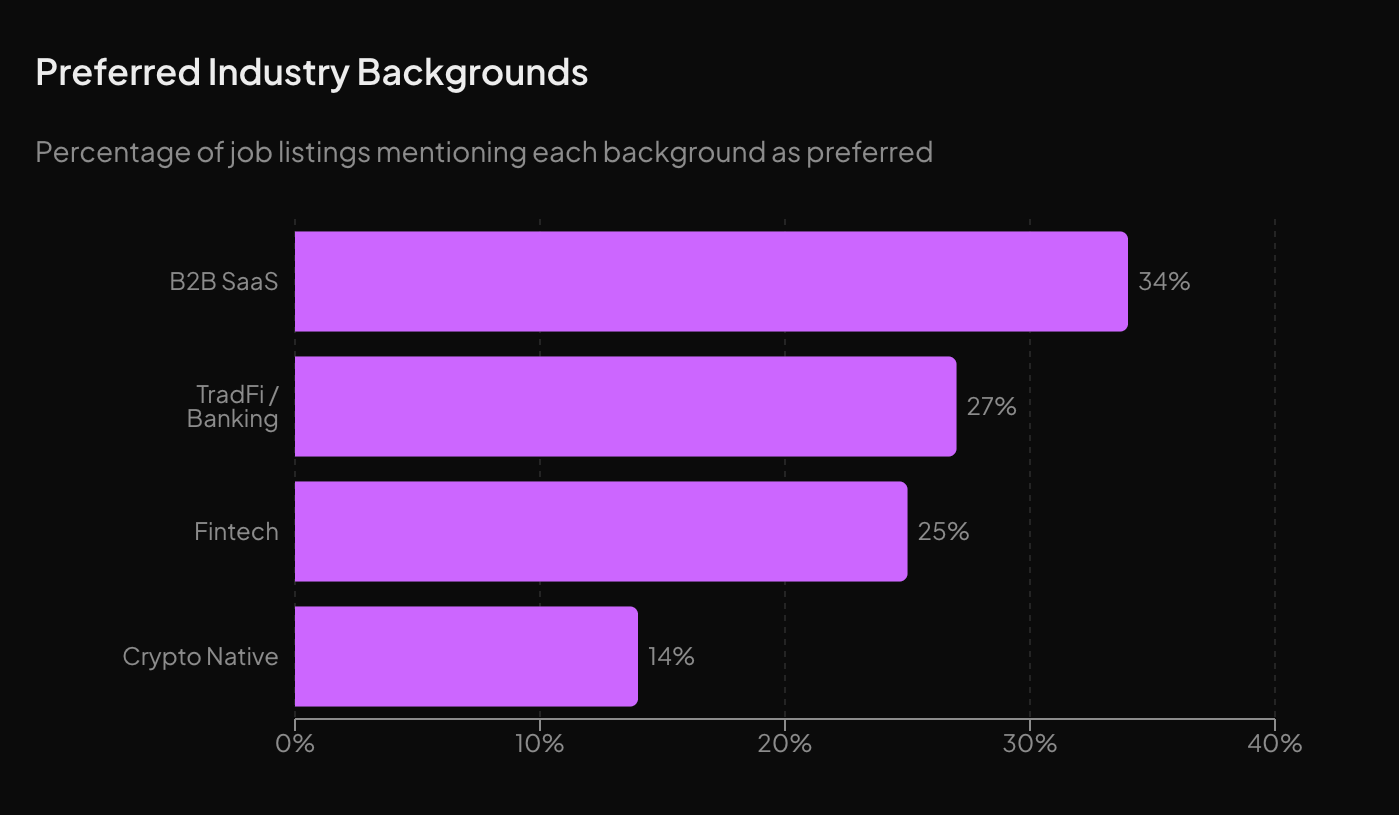
Being crypto native is the least preferred background for these roles.
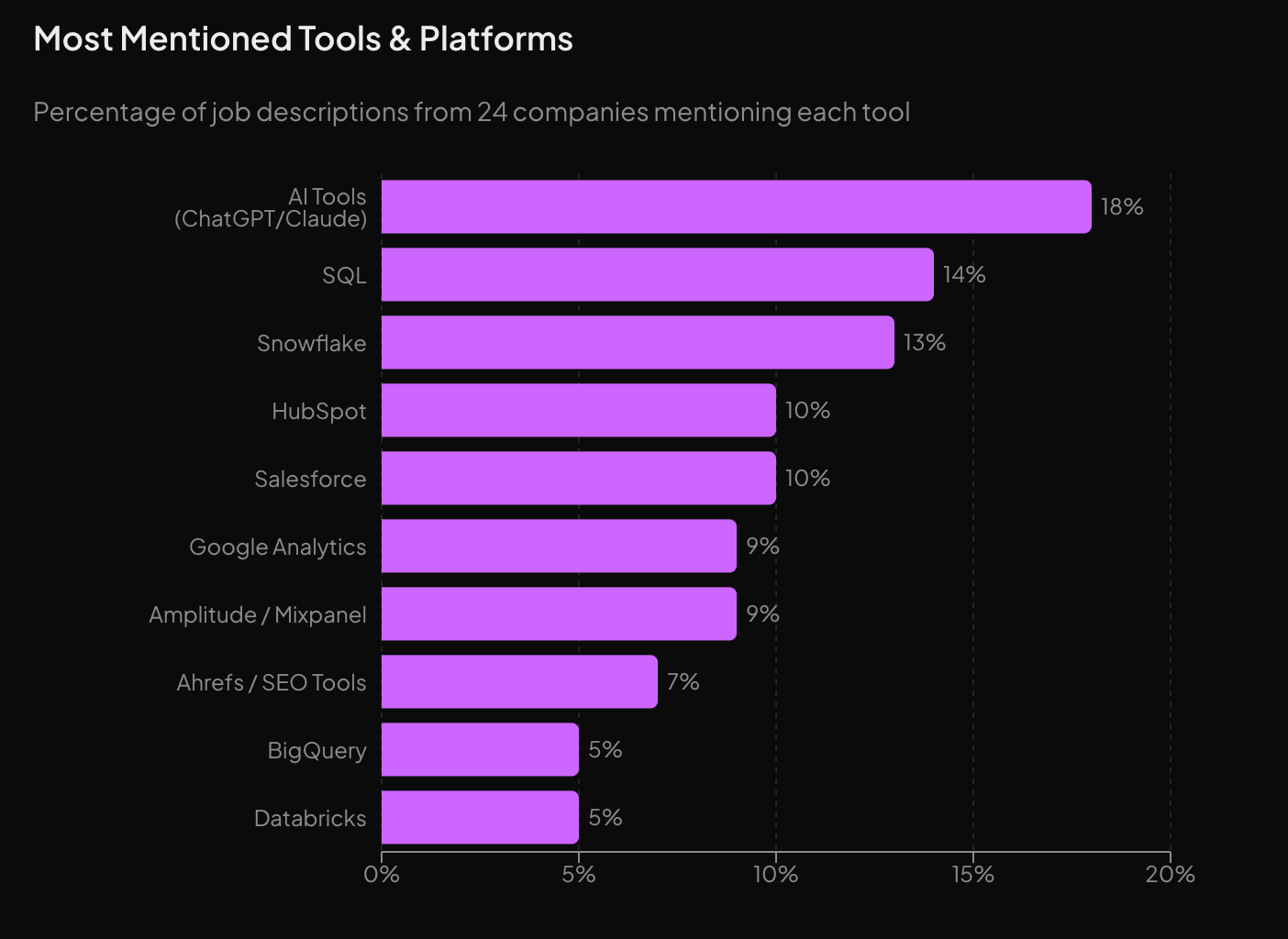
AI leads as the most mentioned tool, with multiple mentions of pipeline attribution tools like HubSpot and Salesforce, and data tools like SQL, BigQuery and DataBricks – tools that are almost never used in regular crypto marketing.
What is crypto institutional marketing?
Institutional marketing in crypto is the act of convincing large, risk-conscious organisations (banks, asset managers, hedge funds, pension funds, regulators, and enterprises) to trust your product with large funds or infrastructure decisions.
Basically, these “institutions” are not individuals making a quick decision on a Monday morning. They are organisations with committees, compliance departments, legal reviews, and procurement processes. A single deal can take 6-18 months and involve 12 different people with veto power.
Who are institutions in crypto?
In crypto parlance, institutions usually refer to large organisations that manage significant capital or infrastructure and operate under strict regulatory, risk, and compliance frameworks.
Examples of institutions in this context include:
Banks exploring custody, settlement, tokenisation, and payments infrastructure.
Asset managers looking to offer crypto exposure, tokenised funds, or on-chain settlement.
Hedge funds trading digital assets, derivatives, and liquidity strategies.
Pension funds and endowments allocating a small portion of portfolios to crypto through regulated vehicles.
Fintech companies integrating blockchain rails for payments, settlement, or asset issuance.
Corporations and enterprises experimenting with treasury management, tokenisation, or cross-border payments.
Regulated exchanges, custodians, and infrastructure providers building the backbone of institutional crypto markets.
How is institutional marketing different from retail crypto marketing?
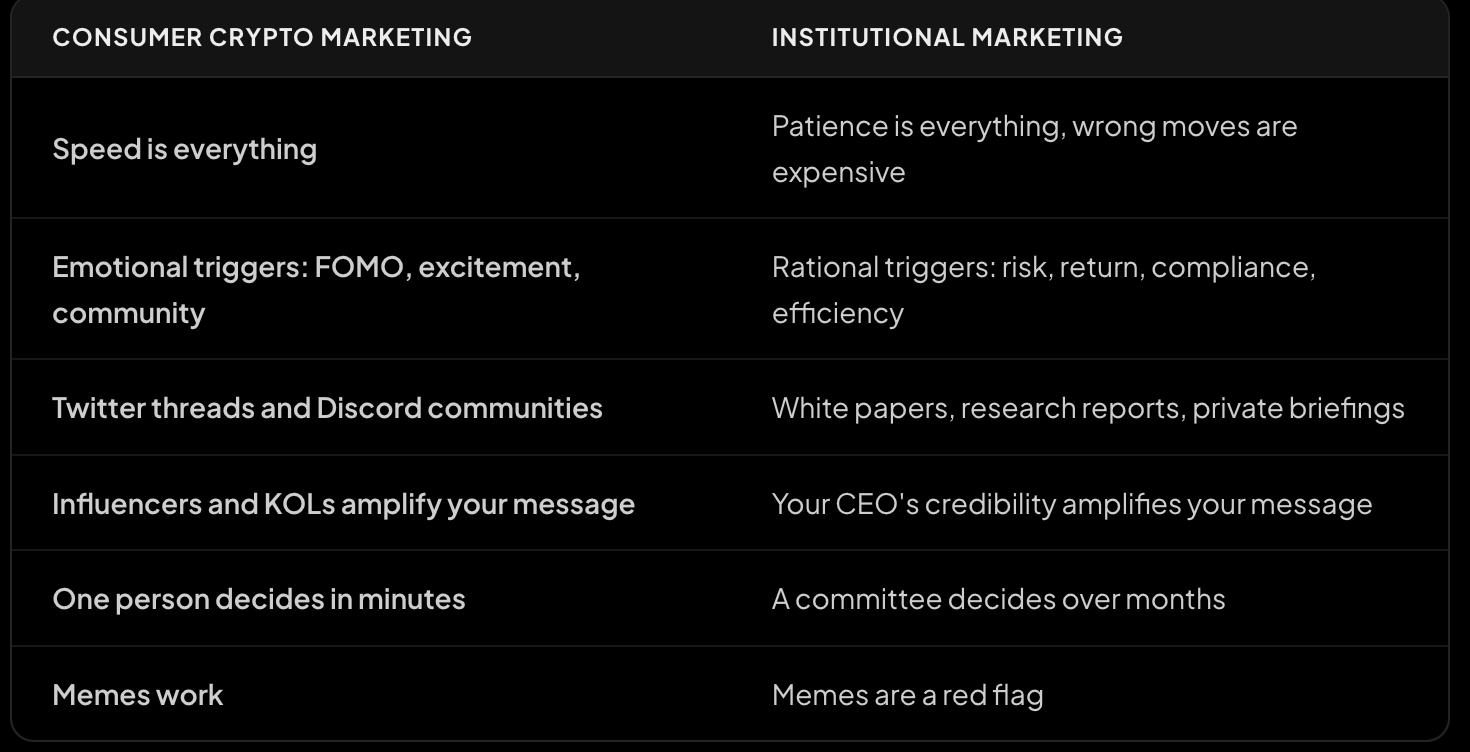
The major difference between institutional marketing in crypto and retail crypto marketing is in how decisions are made. A retail trader can buy a token in minutes. Whereas, an institution may spend months evaluating regulatory exposure, counterparty risk, integration requirements, operational costs and reputational impact.
The table below from the playbook, further simplifies this.
Why is crypto institutional marketing suddenly in demand?
Because the buyer in crypto is changing.
For a long time, crypto growth was driven largely by retail speculation. Token launches, meme coins, and trading cycles brought millions of individual users into the market.
But that is gradually changing. Institutional capital is now entering the ecosystem, and the numbers show the transition is already underway.
According to the Coinbase and EY-Parthenon Institutional Investor Digital Assets Survey, 77% of institutional investors are exploring tokenized assets, with an average target allocation of 5.6% of portfolios. Also, one of the biggest barriers holding institutions back, regulatory clarity, began easing off in 2025.
77% of institutional investors are exploring tokenised assets.
~ Coinbase
The buyers in this case, are large financial institutions deploying blockchain infrastructure in real markets. And that requires a completely different approach to marketing.
How do crypto companies attract institutions?
Institutional investors are not persuaded by hype, token launches, or viral marketing campaigns. They allocate capital when the following conditions are clear:
the infrastructure is secure and private.
the system is compliant with regulatory frameworks.
the product improves existing financial workflows.
In other words, institutions adopt crypto when it solves a real operational problem, not when it promises a revolutionary future.
(More details of how crypto companies attract institutions in chapter 3 : “What Institutions Need From DeFi”)
What skills do crypto institutional marketers need?
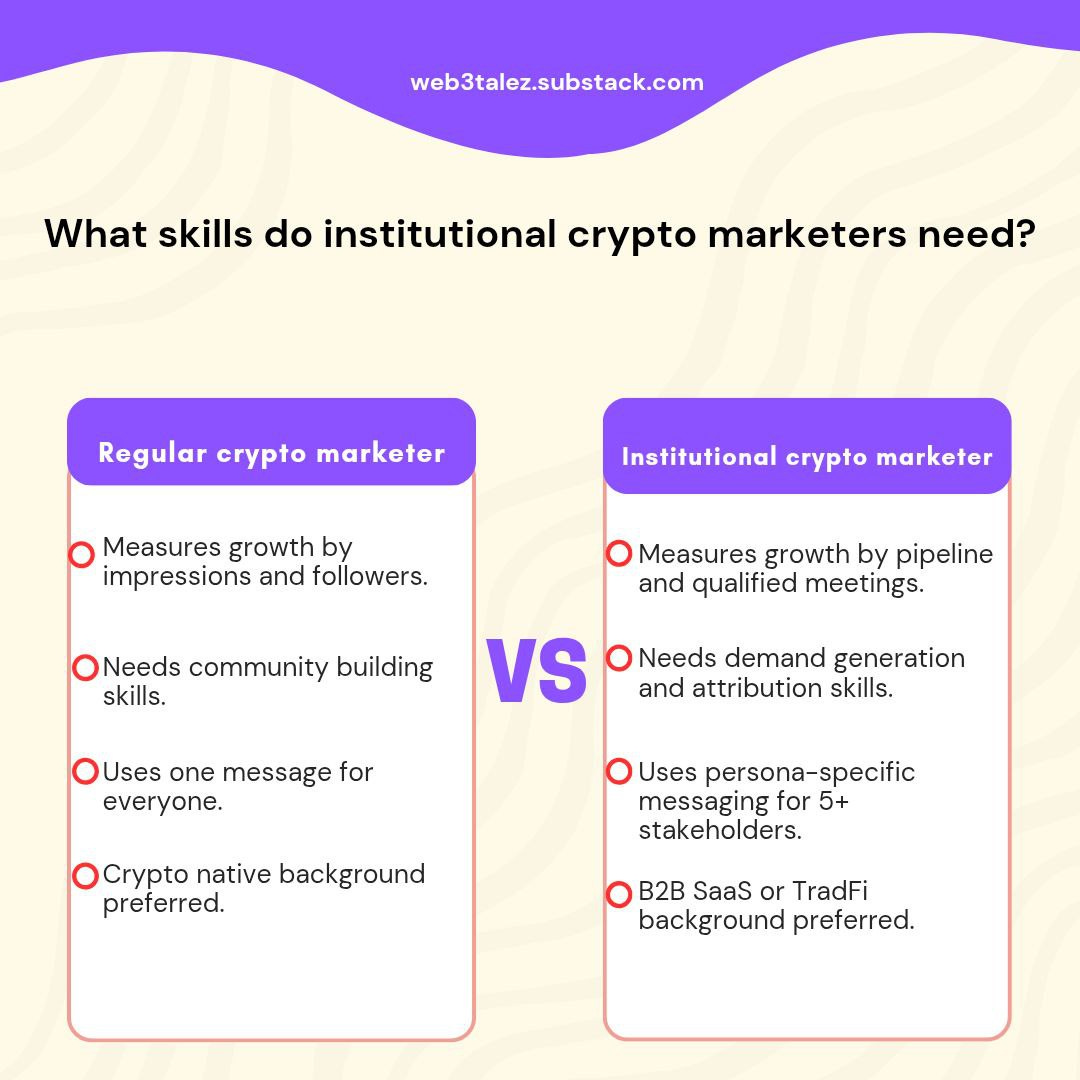
Institutional crypto marketing is not social media management. It is closer to enterprise B2B marketing, combined with financial market literacy.
Looking across job descriptions from companies like Fireblocks, Chainlink, Ondo Finance, and Anchorage Digital, the same skills appear repeatedly.
1. Demand generation and pipeline thinking
Institutional crypto marketers are expected to generate qualified pipeline, not just traffic.
Because a deal with a bank, hedge fund, or asset manager can take 6–18 months and involve multiple stakeholders. Marketing must support that entire journey.
That means understanding:
how prospects discover your company
what content they read during quiet evaluation
what information helps them justify the decision internally
Here, success is measured by content-to-meeting conversion and pipeline contribution, not impressions or followers.
2. Institutional content strategy
Institutions do not want entertaining content. They want content that helps them say yes. The most effective formats include:
Research reports and white papers
Case studies with named institutions
Regulatory explainers
Sales enablement materials
Executive thought leadership
A compliance officer must be able to cite your content internally. If the content cannot survive scrutiny in a risk committee or board meeting, it will not move the deal forward.
3. Understanding enterprise buying processes
Institutional crypto marketers must understand how financial institutions actually make decisions. A single deal may involve:
a digital assets lead
a compliance officer
legal teams
technology teams
a CFO controlling the budget
Each of these stakeholders evaluates the product differently. Marketing therefore needs persona-specific messaging and documentation that addresses each group’s concerns.
4. Founder and executive positioning
In institutional markets, trust is the most valuable marketing asset.
Before approving a vendor, decision-makers often research the leadership team. What they find becomes part of the evaluation. This is why many crypto companies invest in founder-led thought leadership, particularly on LinkedIn.
Consistent writing from founders about market trends, regulatory developments, and institutional adoption builds credibility long before a sales conversation begins.
5. Sales enablement
Institutional marketing works closely with sales. Marketing teams are responsible for producing the materials that help the sales department defend the decision to adopt your product.
These include:
pitch decks
one-page summaries
regulatory documentation
security certifications
ROI models
In many cases, these materials determine whether a deal progresses or stalls.
6. Pipeline attribution and marketing analytics
Institutional marketing requires long-cycle attribution models. A single deal might involve many touch points:
a research report
a webinar
a conference interaction
a case study
a sales conversation
Strong institutional marketers track first-touch, last-touch, and multi-touch attribution to understand which content moves deals forward. This allows marketing leaders to prove exactly how content contributes to pipeline and revenue.
Messaging – How to talk to institutions
Most crypto companies do not fail because of bad products. They fail because of how they communicate those products.
Institutional buyers do not respond to crypto-native language, hype, or technical depth without context. They respond to clarity, proof, and risk reduction.
You can have a strong infrastructure, regulatory readiness and real product-market fit but your messaging could deter institutions from signing any deal.
From the Crypto Institutional Marketing Playbook, these are the messaging rules that determine whether you get a meeting or get ignored.
Outcomes before technology
Institutions care about what changes for them, not how your tech works.
❌ We use decentralized oracle networks.
✅ We help financial institutions settle transactions in real time without legacy overhead.
Proof replaces claim
Here, claims are vanity metrics.
❌ The most trusted institutional platform.
✅ Trusted by BNY Mellon, BNP Paribas, and ANZ Bank, used in production, not pilot.
Match the reader’s language
Most institutional buyers are not thinking in crypto terms. They think in terms of :
compliance
auditability
operational efficiency
risk exposure
So your job is to translate what you have to what they understand otherwise you lose them.
Respect their fear
Institutional decisions are shaped by career risk. If a decision goes wrong, the downside is immediate and the accountability is personal.
But if a decision goes right, the upside is often invisible. So messaging that sounds like: “Don’t get left behind” feels risky.
A messaging that sounds like: “Used by institutions already operating under full regulatory frameworks” feels safer.
Position against the incumbent
When positioning, bear in mind that you are not competing with another protocol but most times with existing infrastructure,legacy systems and internal processes.
So positioning should sound like this:
Settlement in minutes instead of two-day banking cycles
Audit-ready infrastructure that fits existing compliance workflows.
and NOT this:
We are the fastest L1 chain.
Your positioning should speak directly to where they (the institutions) are and how your infrastructure can be of help to them.
7 common mistakes crypto marketers make with institutional marketing are:
Using a hype-driven Crypto Twitter tone rather than an evidence-based, compliance-friendly tone in messaging.
Treating launch as the peak instead of the start of a long (usually 6-18 months) evaluation cycle.
Using the same message for every stakeholder regardless of role and institution niche.
Leading with product features instead of social proof and real adoption.
Building marketing in isolation from sales conversations.
Competing on technology instead of positioning against trusted incumbents.
Pitching “rip and replace” instead of integrating into existing systems – it’s easier to get in by creating small seamless entry points that minimise disruption and fit within existing workflows instead of pitching that the institutions discard their existing workflow.
Practical: Create your demand generation pipeline and test yourself
The final chapters of the Crypto Institutional Marketing Playbook contains practical tools.
Chapter 16 provides a demand generation checklist you can use to create founder content and other content, and to track the leads that come in.
Chapter 17 includes a simple assessment with 20 questions and answers to test your understanding on crypto institutional marketing.

Need help with institutional crypto marketing?
Send me an email or a DM on LinkedIn
I share case studies and marketing tips twice a month, written simple enough that anyone can follow along whether you are deep in crypto or just curious about it.
Web3 marketing stories are boring BUT NOT HERE!
Web3talez