
In this research:
Does fixing an old article actually help it perform better in AI search?
Which grows faster after content updates: Google Search or AI visibility?
Do articles that gain Search visibility also gain AI visibility?
Can an article lose Google Search visibility but gain AI visibility?
Do most updated articles benefit, or do a few drive the growth?
Were AI impressions already increasing before the updates?
Where did the most AI visibility growth come from?
Do higher impressions translate into more clicks and website visits?
Which content fixes make the biggest difference?
Should you update old articles instead of publishing new ones?
Does Google favour recently updated content?
How long does SEO take to improve after a content update?
Do you need special AEO or GEO techniques to appear in Google AI?
Should you create separate articles for every AI fan-out question?
Does fixing an old article actually help it perform better in AI search?
By “fixing,” I mean substantial content rewrites, metadata updates, internal linking, structured data, images, and other technical SEO corrections.
You know, it can be difficult to tell which strategies actually move the needle when it comes to AEO/GEO, and that’s where this publication comes in.
As someone who has been knee-deep in managing AEO/SEO for a Tier 1 crypto exchange, I’ll give you this advice for free: one of the biggest things that can move the needle across SEO, GEO, and AEO is updating existing content.
And I don’t mean updating content just for the sake of it. I mean making meaningful improvements that directly address search intent and make the content more helpful to your target audience.
Two weeks ago, I shared a report that covered whether Search and AI favour the same content. While working on that report, I got the idea for this one. So, consider this a follow-up. You might want to read the previous report first for some context.
Now let’s get right into it!
First, you must know these 3 things about Google’s AI visibility data.
Google’s AI search features build on traditional Search ranking systems, retrieve indexed pages, and explore related queries.
Google measures AI visibility by counting how often a website’s links appear to users in AI Overviews and AI Mode.
Google Search and Generative AI impressions overlap as shown in this report I published.
What exactly was studied for this report?
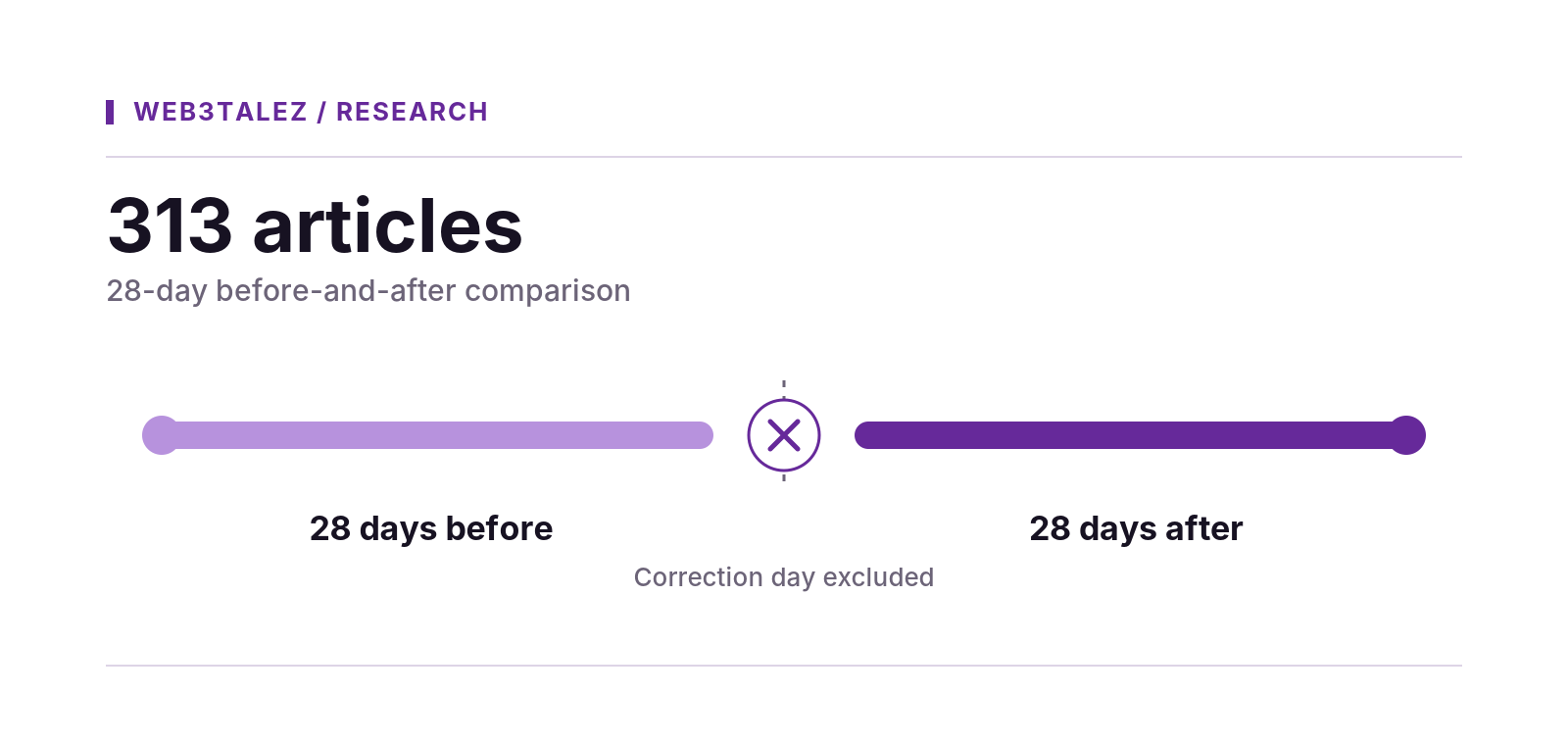
This report examined 313 articles. For each of the 313 articles, I compared its performance over the 28 days before and the 28 days after the documented date of “fixes”. I excluded the day the correction was made to keep the comparison consistent.
The idea was to see how each article performed before and after it was updated.
Did Google Search improve after fixes?
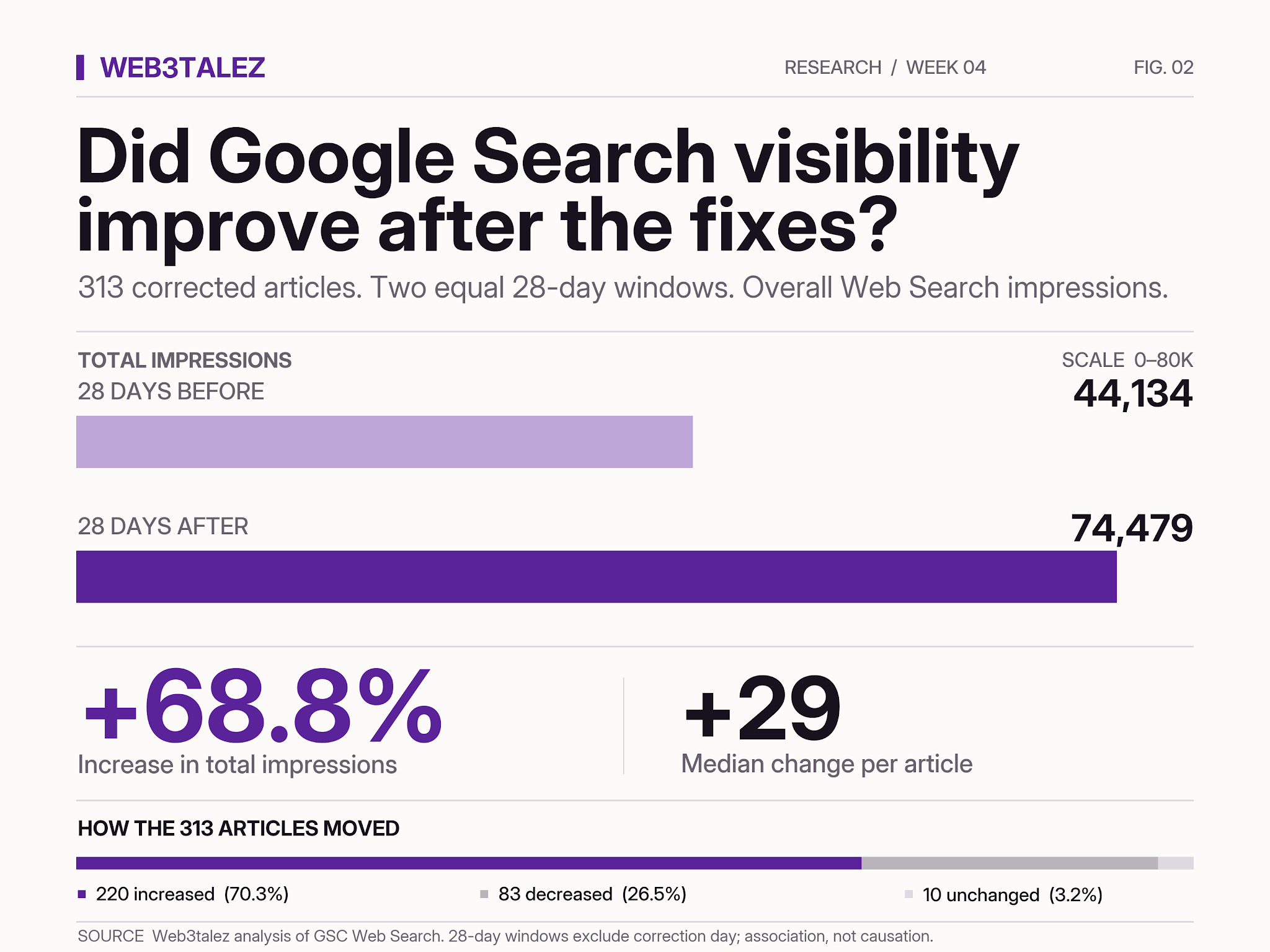
Yes. Overall Google Search impressions increased by 68.8% across the 313 articles.
In the 28 days before the corrections, the articles generated a combined 44,134 impressions. In the 28 days after that it rose to 74,479. That’s an increase of 30,345 impressions (68.8%).
But, here’s where the overall percentage becomes less helpful.
Of the 313 articles, 220 gained Search impressions, 83 declined, and 10 remained unchanged. And the median article gained only 29 impressions.
In other words, the overall improvement was substantial, but it wasn’t equally shared. A relatively large increase across hundreds of pages doesn’t mean every article suddenly became much more visible.
That made me curious about the AI results.
Did AI visibility improve too?
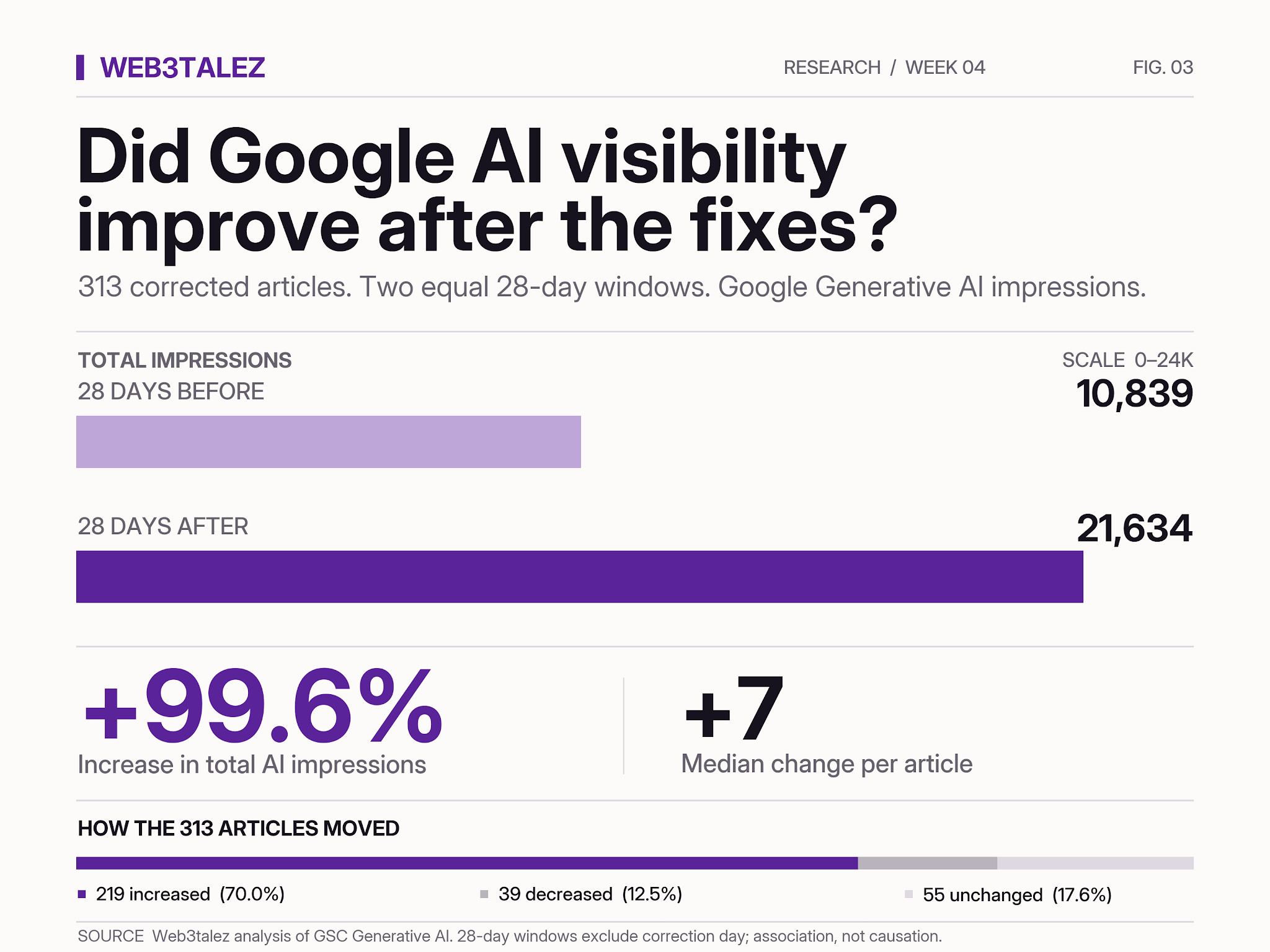
Yes. Generative AI impressions increased by 99.6% across the same articles 28 days after.
Before the fixes, the 313 articles generated 10,839 impressions in AI visibility. Afterward, they generated 21,634. That’s 10,795 additional impressions.
Unlike a result driven entirely by a handful of pages, the number of articles gaining AI visibility was also notable.
From the 313 articles:
219 gained AI impressions.
39 lost AI impressions.
55 remained unchanged.
So 70% of the articles with complete AI comparisons gained visibility. The median page gained just seven impressions.
What does a Google AI impression actually mean?
It means a link to the website was shown to a user in a supported Google generative search experience, including AI Overviews or AI Mode. It does not automatically mean the person clicked the link, visited the website, or became a customer.
Google’s Generative AI performance report covers data that is also included in the broader Web Search performance report. So the two measurements overlap. They aren’t separate, mutually exclusive traffic channels.
Therefore, this research helps to examine visibility specifically within Google’s generative features.
Which grew more: overall Search or Google AI visibility?
Google AI visibility saw the larger percentage increase in this sample. Overall Google Web Search impressions increased by 68.8%, while impressions recorded in Google’s Generative AI report increased by 99.6%.
These findings suggest that updating existing content can improve both overall Search performance and AI visibility. However, because this was a before-and-after study, the results show an association rather than proving that the fixes alone caused the improvements.
Personally, I’ve also noticed that when trends shift search intent, an article can see a surge in AI visibility without me making any changes to it.
This is worth considering because an increase in visibility doesn’t always mean a content update was responsible. Sometimes, changes in what people are searching for can influence how an existing article performs.
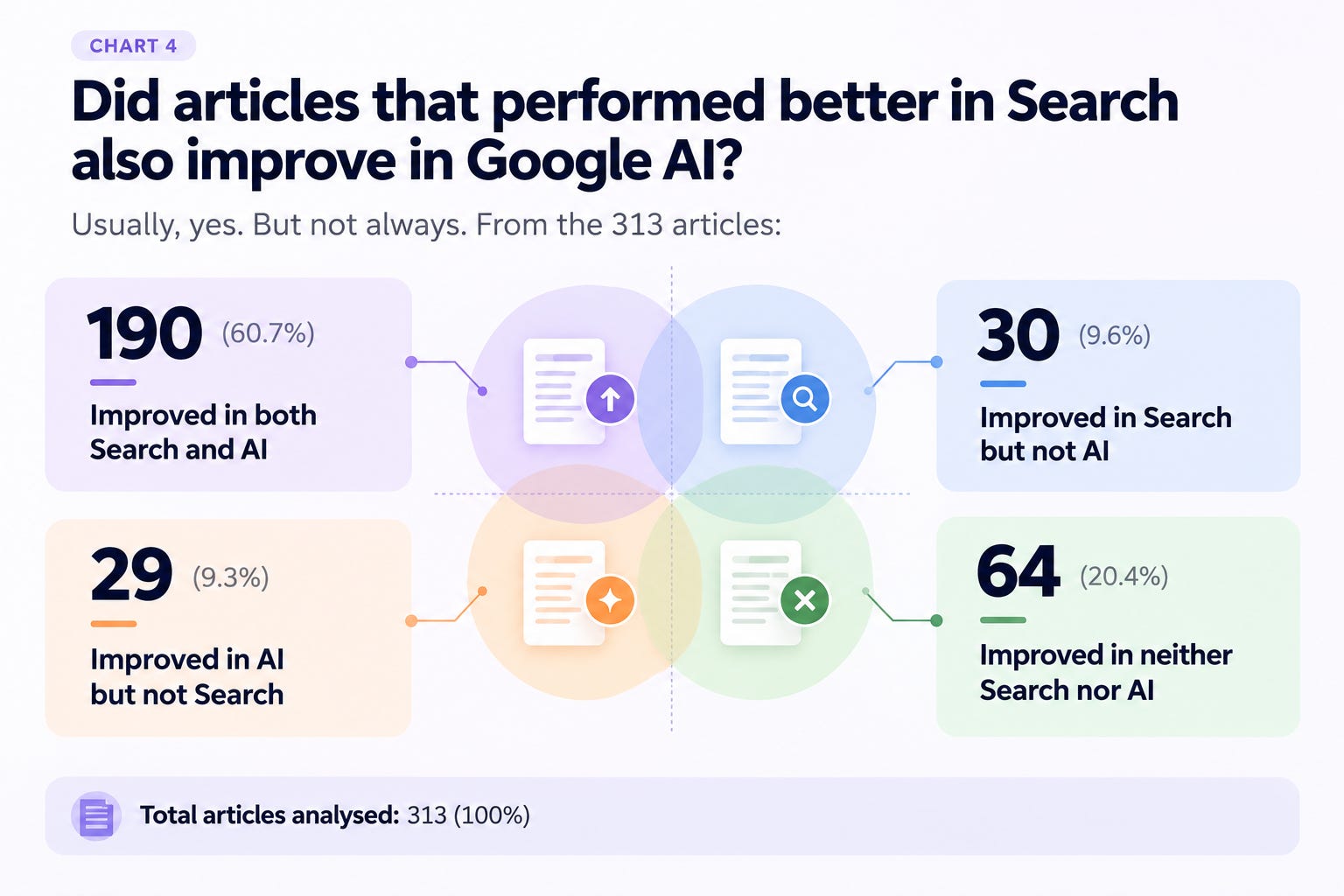
Did articles that performed better in Search also improve in Google AI?
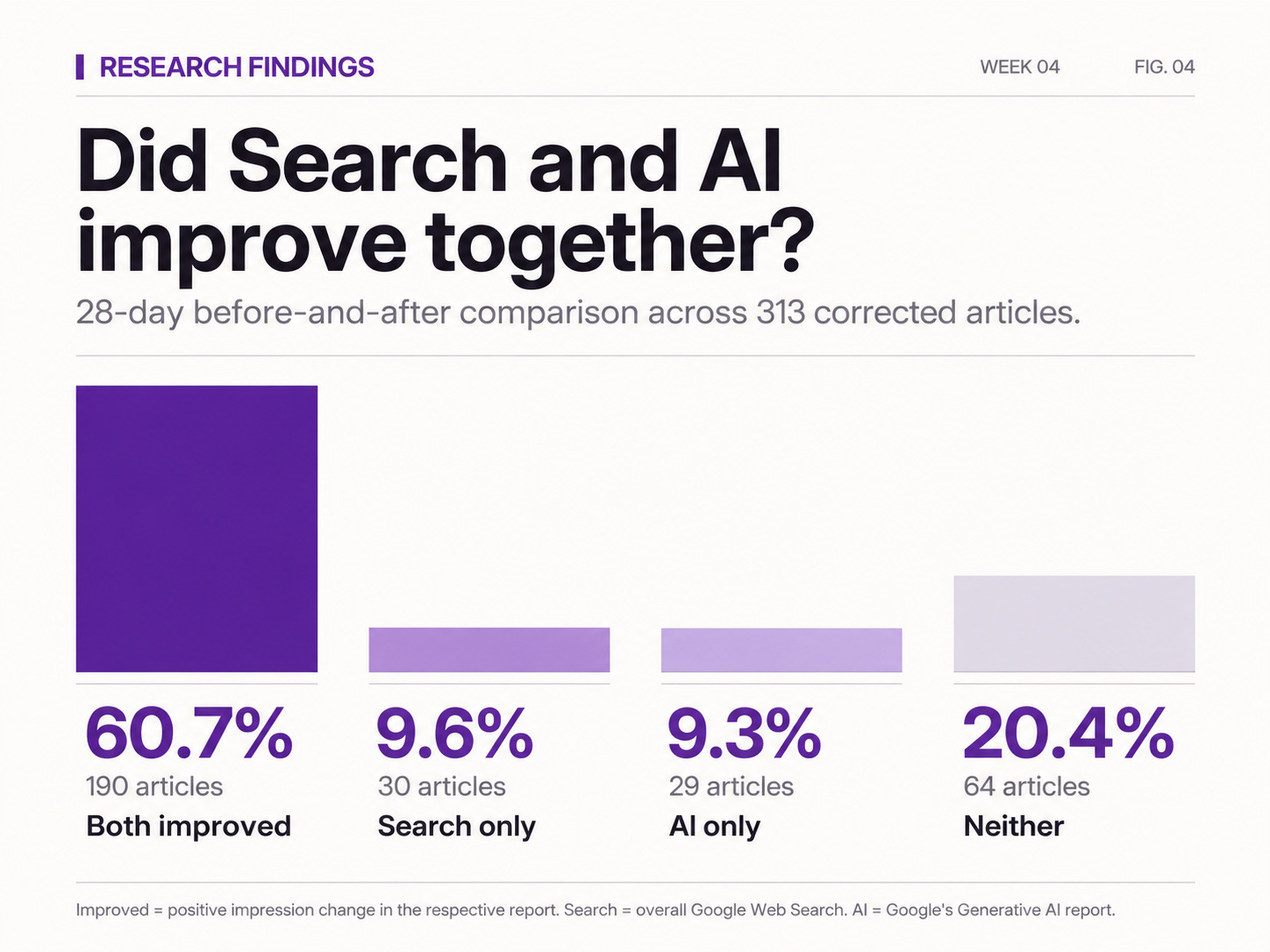
Usually, yes. But not always. This was one of the most interesting findings.
From the 313 articles:
190 improved in both Search and AI.
30 improved in Search but not AI.
29 improved in AI but not Search.
64 improved in neither.
I also compared how much each article gained or lost in both measurements to see whether they followed a similar pattern. And for the most part, they did.
Articles that gained more impressions in overall Search generally saw larger gains in AI visibility too. Part of this relationship may be explained by something we’ve already established in this report: Google AI impressions are included in overall Google Web Search impressions.
What I found particularly interesting were the articles that didn’t follow this pattern. Some gained visibility in one area but not the other, while others gained impressions in one and lost ground in the other.
Can an article lose Google Search visibility but gain AI visibility?
Yes. Twenty-seven articles in this study did exactly that.
These articles recorded fewer overall Google Web Search impressions after correction, but more impressions in Google’s Generative AI report.
How is that possible? Well, Google’s generative search features also uses query fan-out. Instead of relying only on the original question, the system can explore several related searches to gather information for its answer.
It’s just like someone asking:
“What’s the best way to automate a crypto trading strategy without taking unnecessary risks?”
An AI search will usually explore several related questions:
How do automated trading strategies work?
What are the risks of using trading bots?
How do different trading strategies compare?
What should a beginner consider?
These are illustrative questions, not actual fan-out searches observed in this study. But they help explain why a page might still be useful as a supporting source in an AI-generated answer, even when its overall Search performance is moving in a different direction.
One thing worth noting here is that; a decline in overall Google Search impressions doesn’t necessarily mean a page has lost visibility in Google’s AI features. And the reverse can happen too. A page can gain impressions in overall Search while losing visibility in AI.
Did most articles benefit, or did a few pages create the growth?
Both. Many articles gained AI visibility, but the gains were uneven.
Across the 313 articles, 219 recorded more AI impressions after correction. However, the median gain was only seven impressions.
The distribution of gains and losses shows why the overall 99.6% increase doesn’t describe every article’s experience. Some articles gained only a few impressions. Others gained far more.
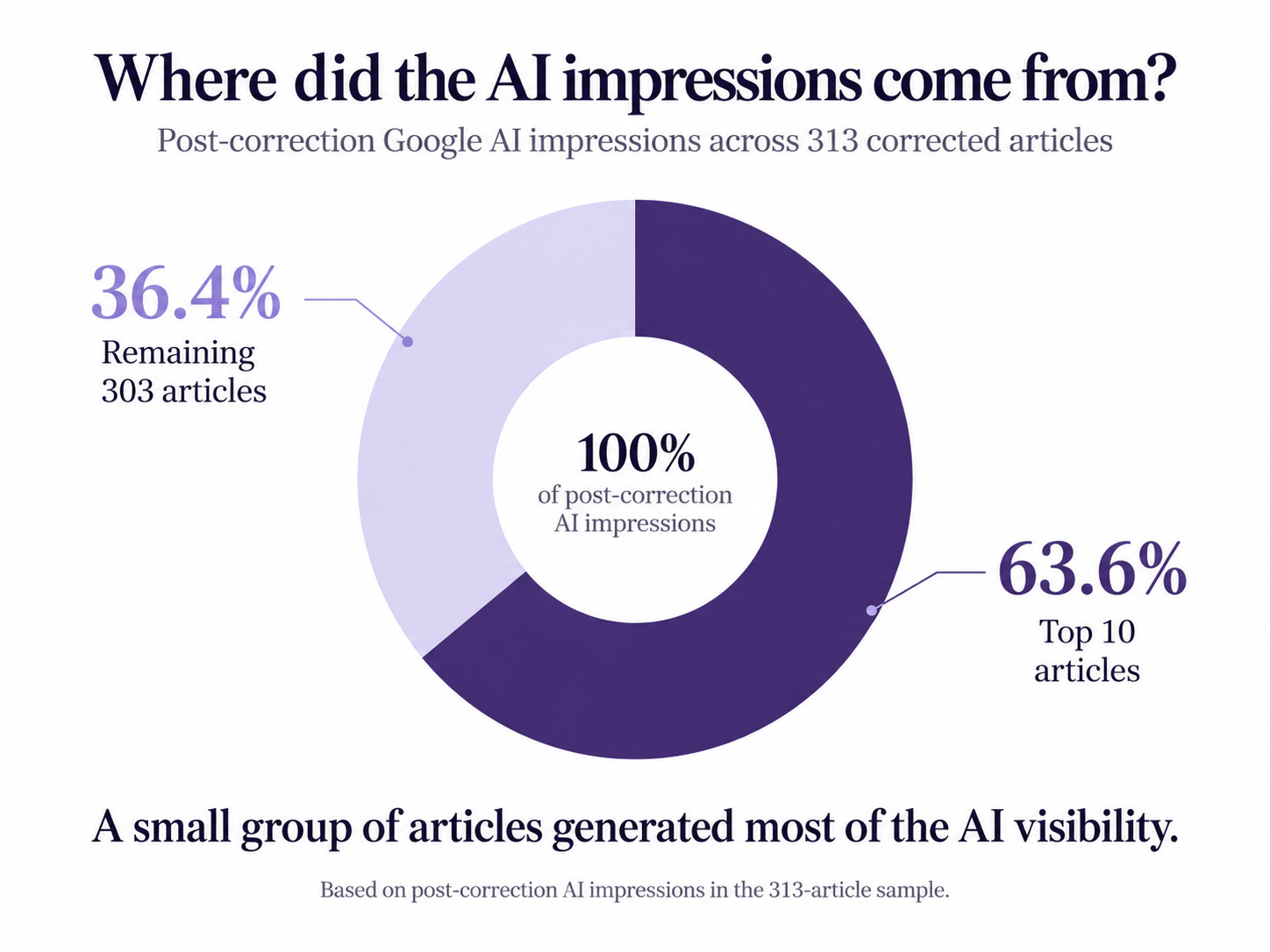
I also looked at which pages accounted for the total AI visibility after correction. The ten most visible articles generated 63.6% of all post-correction AI impressions.The remaining 303 articles accounted for just 36.4%.
Were AI impressions already increasing before the corrections?
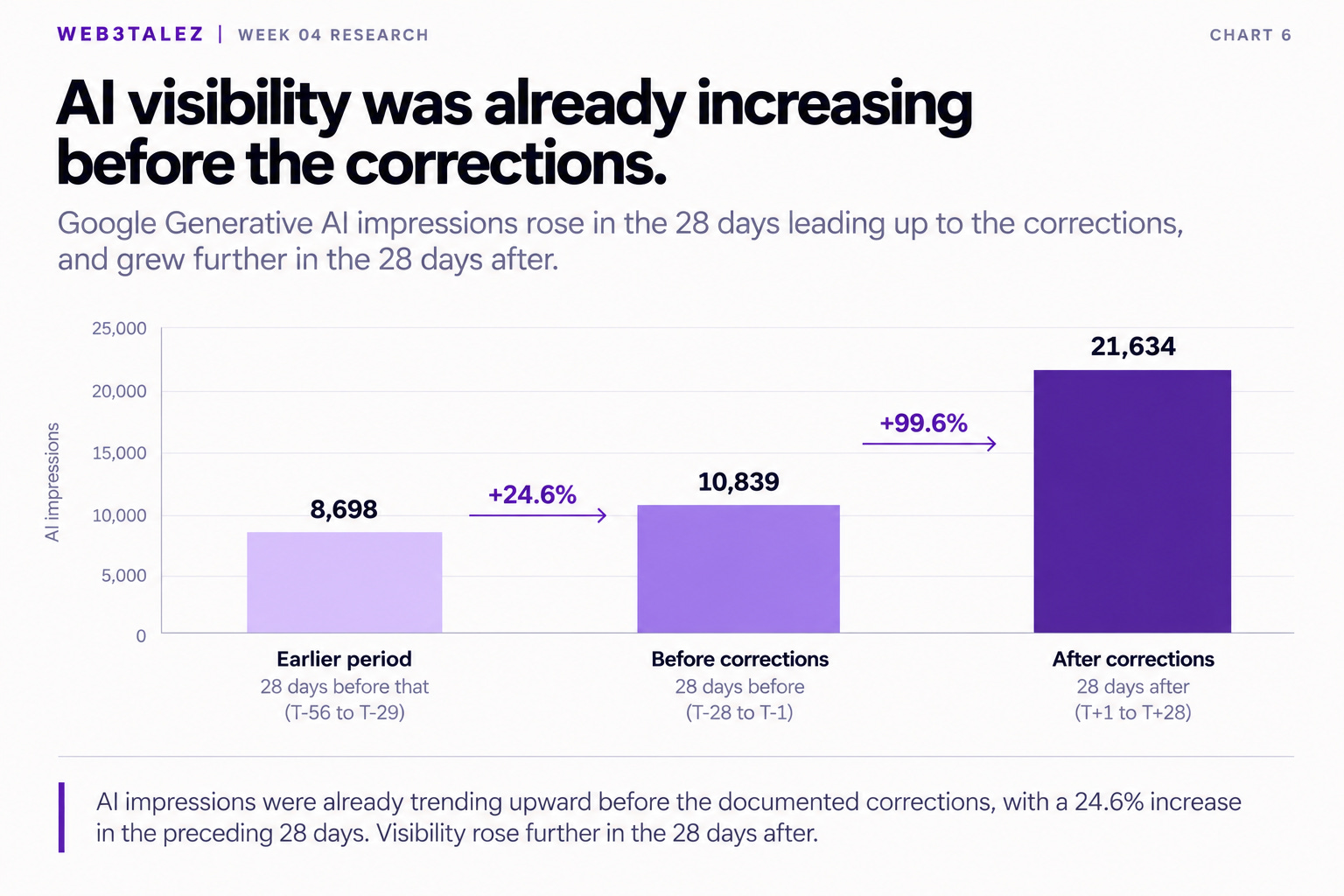
Yes. And this is why the before-and-after numbers need to be interpreted carefully. I examined an additional 28-day period before each article’s immediate pre-correction window. The results were revealing.
View this chart's data as a table
| Period | AI impressions |
|---|---|
| Earlier 28 days | 8698 |
| 28 days immediately before correction | 10839 |
| 28 days after correction | 21634 |
AI impressions had already increased by 24.6% before the fixes happened. Then it increased by 99.6% after 28 days.
Where did the AI impressions come from?
Just 10 articles accounted for nearly two-thirds of all Google AI impressions recorded after the corrections.
I also checked whether removing the articles with the highest impression counts would change the overall results. Interestingly, it didn’t. AI impressions still increased after excluding these high-performing articles, and the typical article also recorded a positive change. This shows the growth wasn’t entirely driven by a handful of popular articles.
Did higher visibility lead to more clicks and website visits?
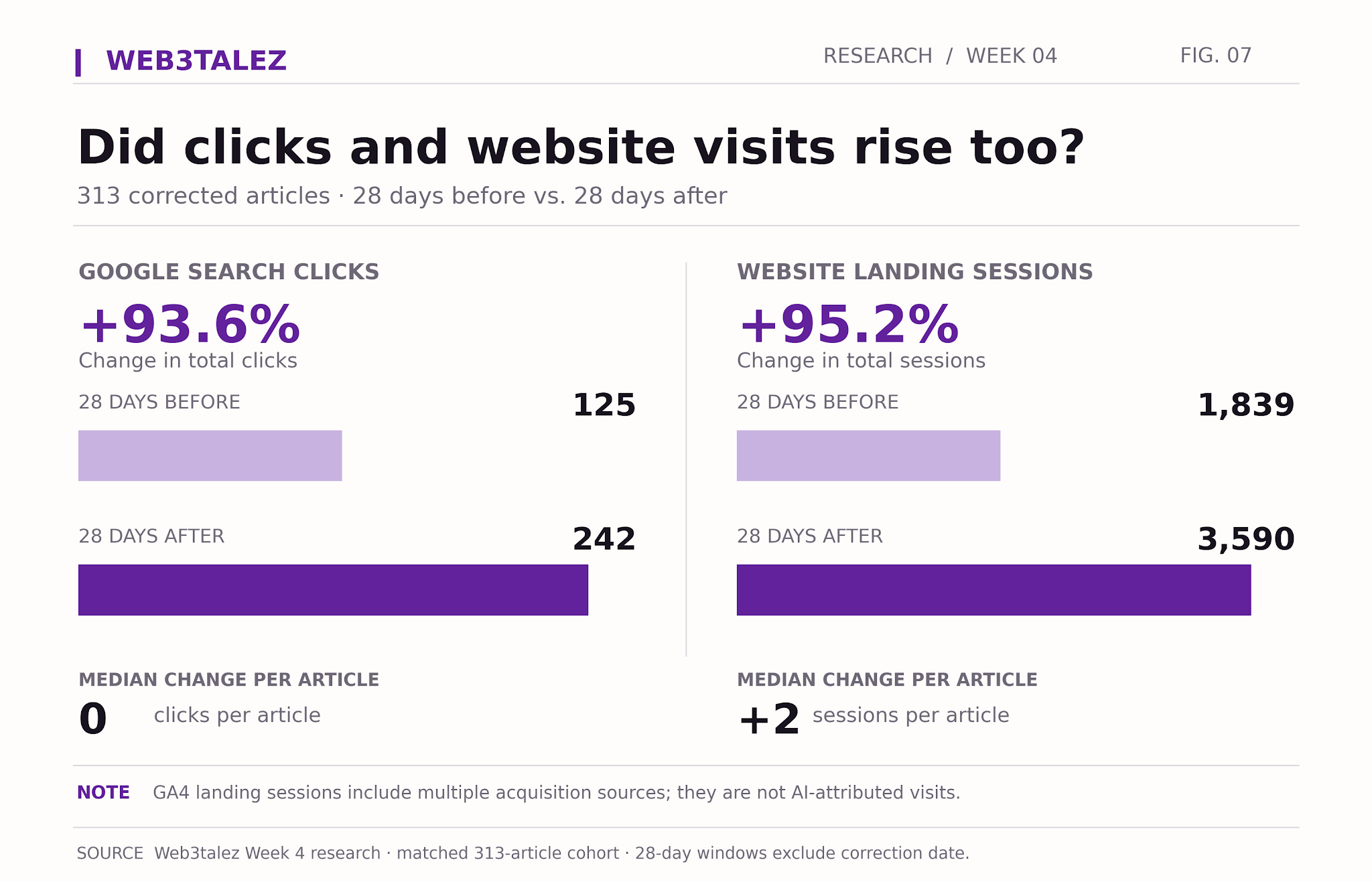
Clicks and website landing sessions increased too, although the typical article saw a much smaller improvement.
Google Web Search clicks across the 313 articles increased from 125 to 242.That’s a 93.6% increase. Website landing sessions recorded in Google Analytics increased from 1,839 to 3,590, or 95.2%.
Which fixes made the biggest difference?
As someone who managed the SEO and AEO efforts behind this data, I can tell you that updating older articles with existing traffic, adding structured data, and improving metadata played a major role in the performance improvements I observed.
So, should you update old articles instead of publishing new ones?
Well, “old” could mean different things.
In this study, old content referred to articles that were no longer aligned with the product’s current features or what users were searching for.
This meant that even when these articles appeared as supporting sources in AI-generated answers, they didn’t necessarily address the user’s specific questions or pain points.
From my experience, a good place to start is by identifying articles that already receive traffic or visibility through Google Search or AI. You should also pay attention to articles with high Search impressions but low clicks.
Then, look at what needs improving. Does the article still answer the user’s questions? Are the examples outdated? Is the explanation incomplete or confusing? Does it reflect the product’s current features?
The goal is to make the content genuinely helpful to the people searching for it.
You can also try this Semrush skill I created, which helped me rank a product-related article within two days of publishing it. (See the experiment here.)
A few other things I’d recommend:
- Measure individual articles, not just website-wide performance. A large increase in total impressions doesn’t necessarily mean every article improved.
- Track AI visibility alongside overall Search performance. Both can tell you something useful about how your content is performing, even though their impression counts aren’t completely independent.
- Document your changes. Record what you updated and when. This makes it easier to understand how your content performs after each improvement.
- Look beyond impressions. More visibility is good, but clicks, engagement, and whether visitors find what they’re looking for matter too.
I wouldn’t recommend updating every old article simply because it has been sitting on your website for years. Start with articles that have existing visibility or clear opportunities for improvement. Make them more useful, address the user’s search intent, and measure what happens afterward.
Does Google prefer newly updated content?
Not automatically. Google has freshness systems that can favour recent information when the topic calls for it.
Changing an article’s date doesn’t guarantee a ranking improvement. However I’ve also observed that new content with proper structure is usually favoured more. (You could check out this experiment for better understanding).
How long does SEO take to improve after a content update?
There isn’t one guaranteed timeline. Changes can take anywhere from days to months to be reflected in traditional search and AI systems. I’ve seen that happen in days most times.
This study used 28-day comparison windows, with additional shorter-window checks, but it wasn’t designed to identify the exact day when a correction began influencing performance.
Do you need special AEO or GEO techniques to appear in Google AI?
For Google’s generative search features, the fundamentals of SEO still matter.
Google’s guidance on optimizing for generative AI Search makes this clear. Pages still need to be accessible, indexable, useful, and relevant. Content should answer real questions well. Internal links should help people and search engines discover related information. Structured data should accurately represent the visible page.
In summary, don’t assume there is a secret AI-specific technical trick that replaces useful content and sound SEO.
Should you create a separate article for every AI fan-out question?
No. Not simply because an AI system might ask that question.
Query fan-out makes it useful to think about the related questions someone may have when exploring a topic. But that doesn’t mean every possible subquestion deserves its own page. A helpful article should answer the main question clearly and cover the related details a reader genuinely needs. Sometimes that can happen within one well-structured article.
Other times, a related question may be substantial enough to justify a separate guide. The decision should depend on whether the additional page serves a distinct reader need, not whether it matches an imagined AI subquery.
That’s it for my letter to you today . See you in your inbox again soon
Want to reach out?