
In this case study:
If a page performs well in Search, does it perform well in AI?
Do Google AI and Bing AI favour the same pages?
Does AI visibility lead to AI referrals?
Where does the most AI traffic come from?
How concentrated was AI visibility across the pages analysed?
The truth is, AEO and GEO are often quite difficult to measure unless there are specific ways to track user retention and new users coming from AI. But when you compare performance at the page level, some clear patterns start to emerge. And some of them challenge what we’ve been told about optimizing content for AI.
Let’s get right into it.
If a page performs well in Search, does it perform well in AI?
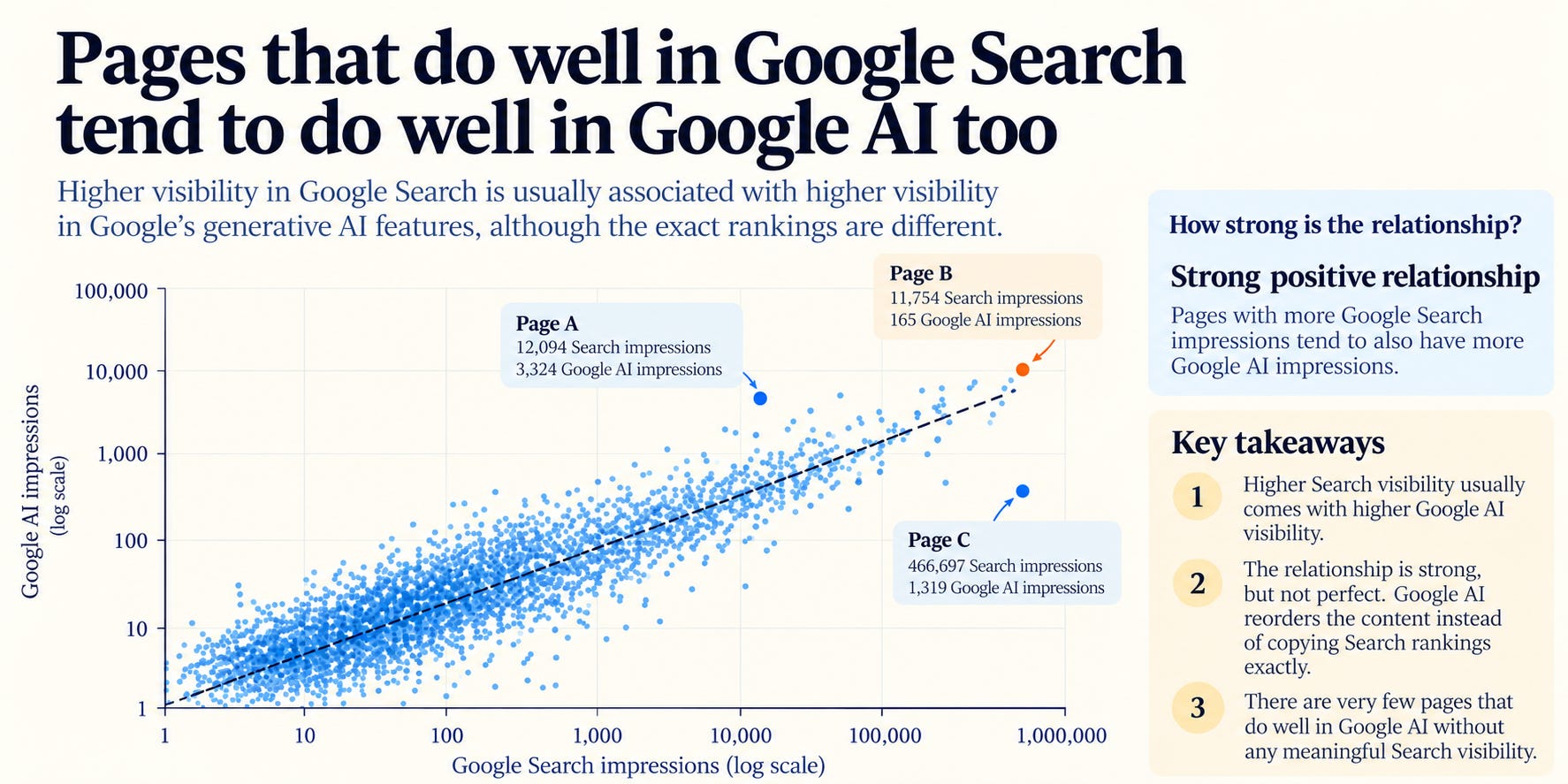
Mostly, yes. Pages with high visibility in Google Search also tended to have high visibility in Google AI. But the interesting part was that the top pages were not exactly the same:
Of the top 10 pages in Google Search, only 4 were also in the top 10 for Google AI.
For the top 25, 15 appeared on both lists. For the top 100, 66 appeared on both.
So Search performance clearly matters, but Google AI does not simply copy the Search results. It reshuffles them.
Another thing stood out.There were no pages with poor Search visibility that suddenly became top performers in Google AI.The strongest pages in Google AI already had meaningful visibility in Search.This makes one thing clear : good SEO still matters for AI visibility.
Do Google AI and Bing AI favour the same pages?
Not really. The difference is much bigger when Google AI data is compared with Bing AI.
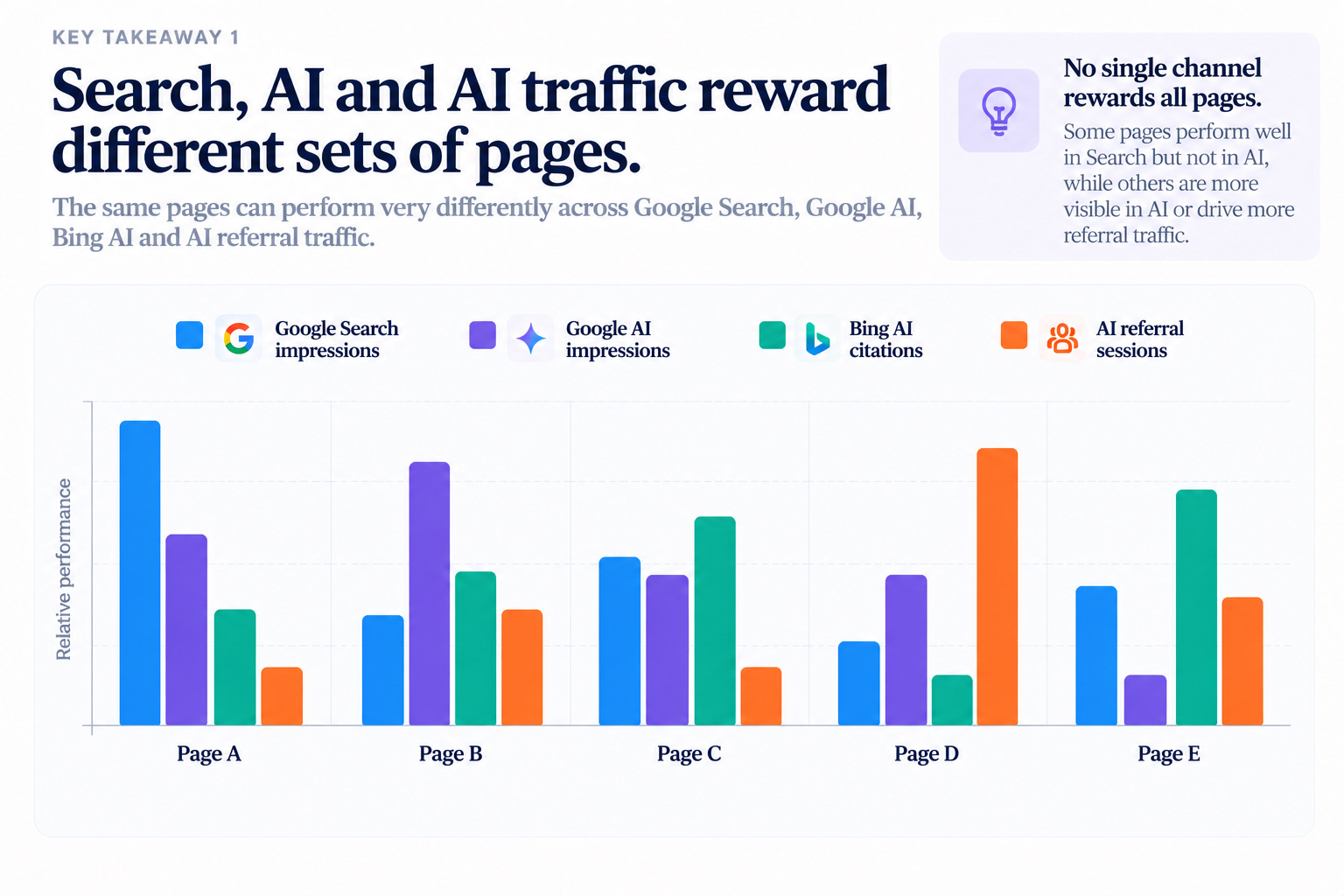
Only 3 of the top 10 pages were the same. For the top 25, only 9 were the same. One page had more than 11,000 Google Search impressions and 4,600 Bing AI citations, but only 165 Google AI impressions.
Notice that it’s the same page but different metric counts across various platforms. Therefore, saying a page has “good AI visibility” could be an ambiguous statement. A page can perform strongly in Bing AI and barely move in Google AI.
Does AI visibility lead to AI referrals?
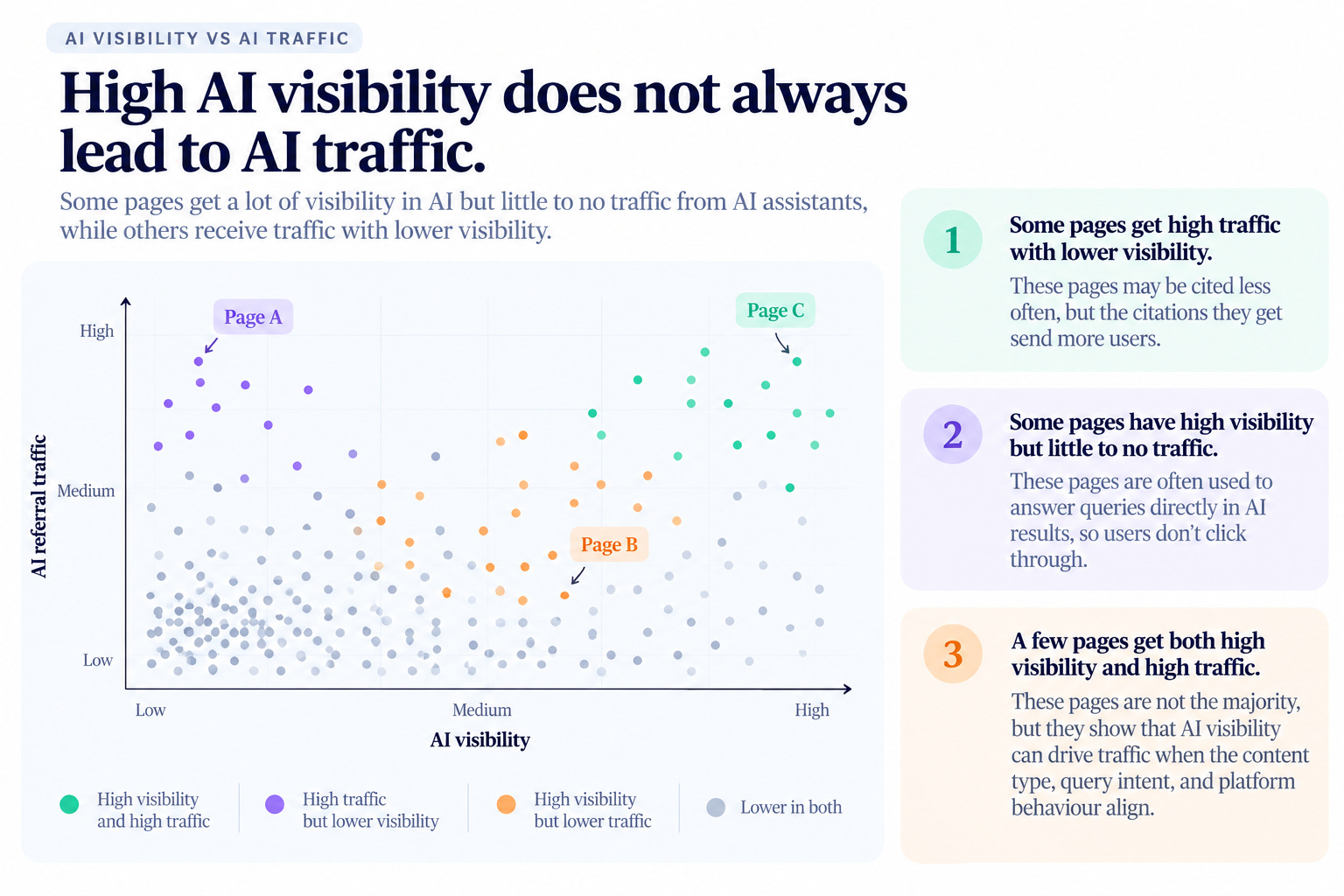
Not always. Out of 681 pages with Google’s AI impressions, only 261 received at least one visit from an AI assistant. 420 received none. One of the pages had more than 3,000 Google AI impressions and over 12,000 Search impressions, but no identifiable visits from AI assistants.
This is where measuring AEO gets tricky because a page can be visible in AI and still send you no AI referral traffic. The user may get the answer directly from the AI result without visiting the source.
So, AI visibility and AI referral traffic are two different things.
Where does the most AI traffic come from?
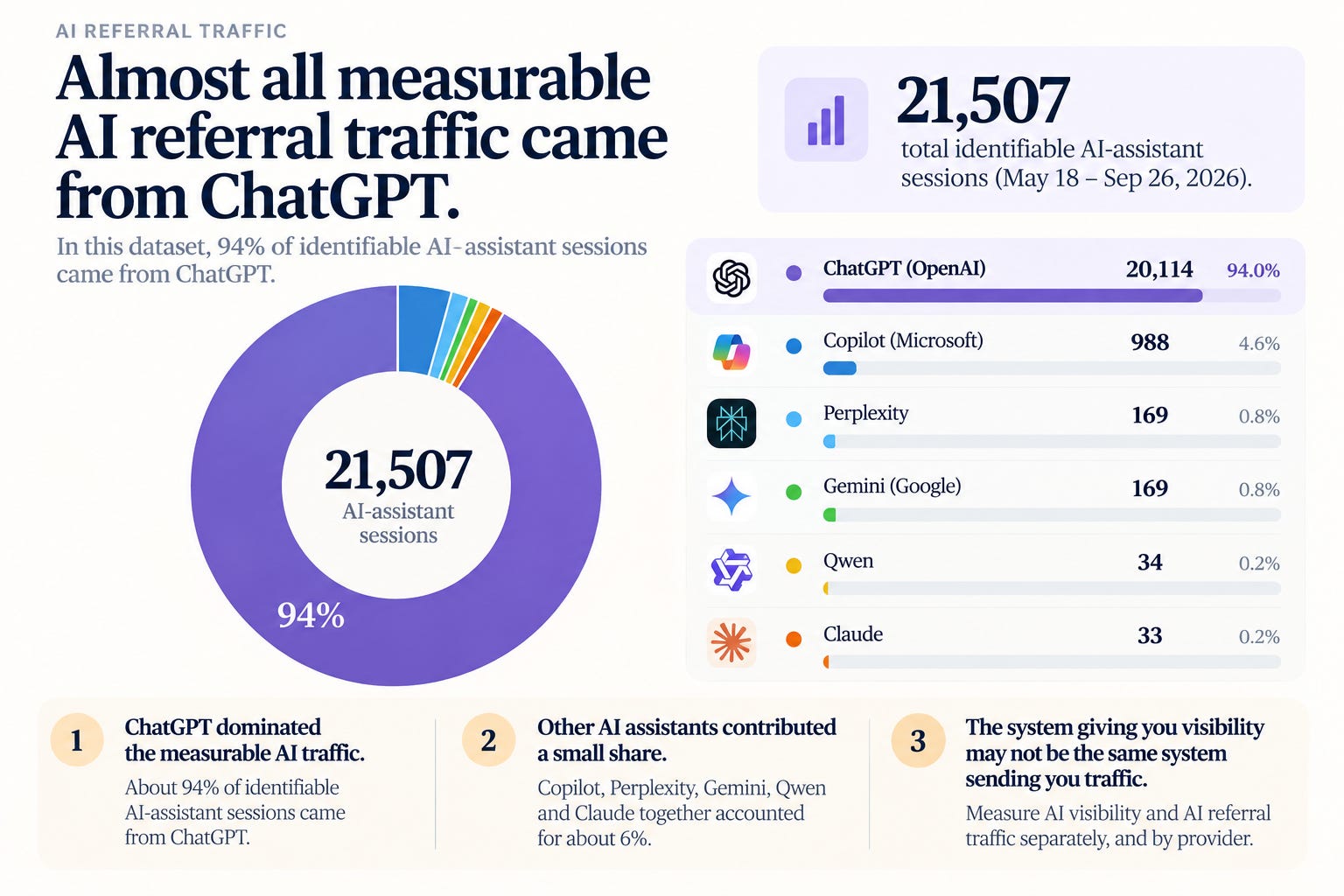
Mostly ChatGPT.There were just over 21,000 identifiable visits from AI assistants during the analysed period. About 94 out of every 100 came from ChatGPT. The rest came from Copilot, Perplexity, Gemini, Qwen, and Claude.
PS: This is specific to the website and period I analysed. It is not an AI search market-share figure.
How concentrated was AI visibility across the pages analysed?
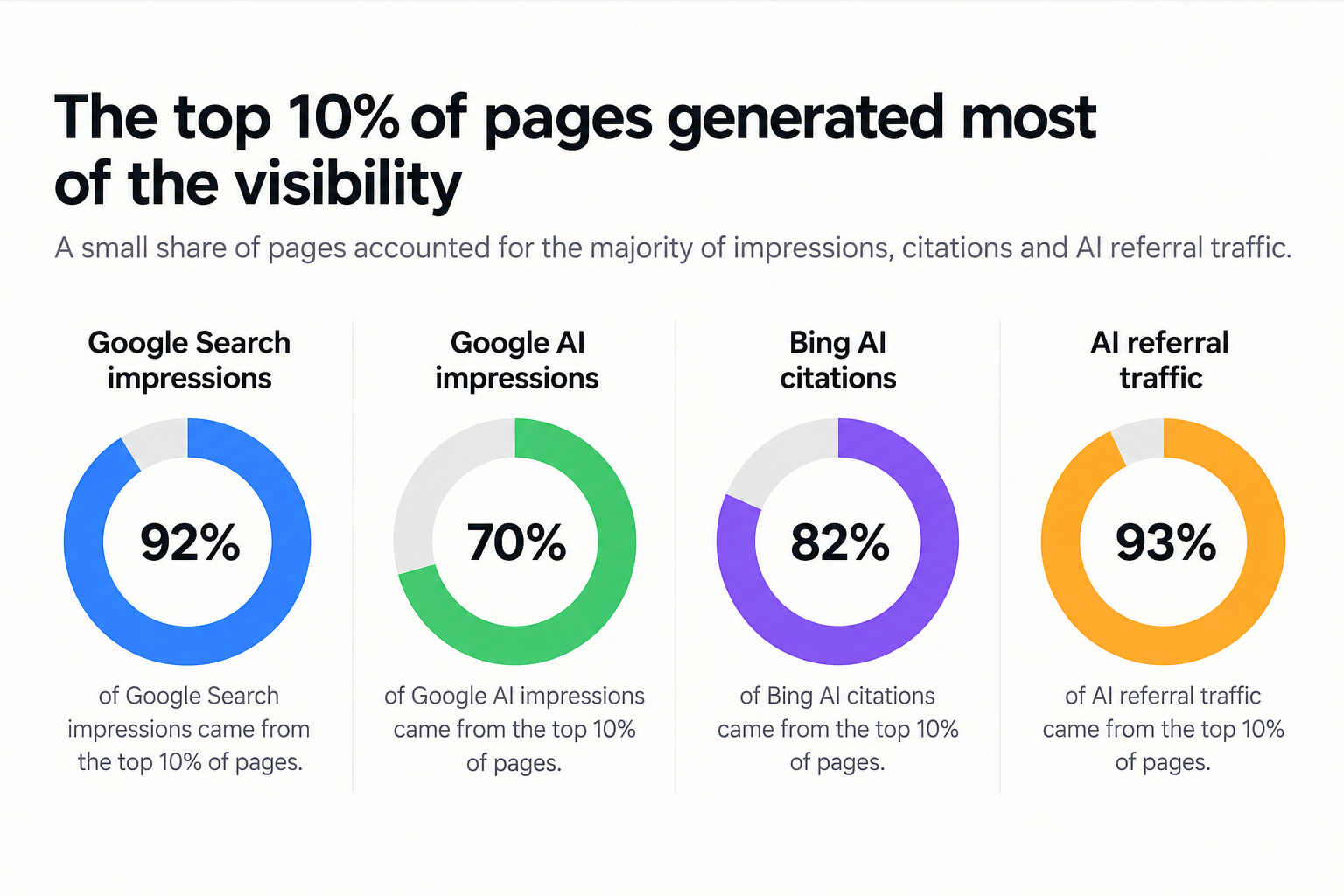
A lot of the visibility came from a relatively small share of pages.
The top 10% of pages generated:
about 92% of Google Search impressions
about 70% of Google AI impressions
about 82% of Bing AI citations
about 93% of AI referral traffic
So while thousands of pages were analysed, a much smaller group accounted for most of the visibility and traffic. This is why sitewide growth can sometimes hide what is really happening. If AI visibility grows, the next question should be:
Which pages are driving that growth?
So does Search and AI reward the same content?
To an extent. From this analysis, it’s evident that:
Strong Search pages were also more likely to perform well in Google AI. But Google AI did not rank those pages in the same order.
Bing AI also favoured a different set of pages, which means strong AI visibility on one platform does not guarantee the same result on another.
AI visibility did not always lead to traffic either. Some pages had thousands of AI impressions but no identifiable visits from AI assistants.
So SEO and AEO are connected, but they are not the same thing.
Search performance appears to give content a strong foundation. What happens after that depends on the AI platform, how it surfaces the page, and whether the user still needs to click through.
That’s it for my letter to you today . I hope this gave you a simpler way to think about the SEO vs AEO debate.
See you in your inbox again soon
Want to reach out?