


Many times it takes the bloody market dips to realize that your marketing strategy was hype-driven – incentivizing users to farm points and chase speculation. Without that artificial sugar rush, there's no reason for anyone to use your dapp.
Now is a good time for evaluation – to think outside the miniature box you've always revolved in – crypto twitter.
The product is the problem
Unfortunately, crypto marketing still 'thrives' in a complexly nuanced bubble – crypto twitter – where the same projects are marketing tonnes of apps that are the 'future of finance' to the same small group of people, who are only interested in the apps that give them points and airdrops. Utility has been chased out of the window.
Hence it makes sense that the charade for mass adoption will only look good on press releases and pitch decks. The current season – the bear market – is a time that exposes the usual strategies when numbers go up: bot followers, fake engagement, paid shillers, wash trading volume, inflated TVL… These tactics work during bull markets because cheap capital and FOMO let speculation overwhelm any need for fundamentals. Now nothing is going up and the rude shock comes to you – “what am I even doing here?”
Market to people who just want things to work
The bear market forces new perspectives on strong believers in the ecosystem. It asks uncomfortable questions:
What if your next 10,000 users are outside crypto twitter and don't care about decentralisation?
How do you meet them?
What changes do you have to make to adjust the product to their taste?
The moment you step outside ct you'll discover the people you should be marketing to are not problem aware. Using crypto language would be a huge turn off for them.For Gnosis, an infrastructure company that once focused only on crypto insiders, they discovered people knew the brand but didn't know why they should care. So their approach was to turn complex crypto language into something everyday users find interesting while deliberately avoiding crypto parlance.
How they did it
They transitioned from "web3 infrastructure" to "everyday utility.” This translated in their messaging and design. Messaging became direct, speaking to “you” instead of hiding behind technical jargon.
Rather than building another on‑chain tool, Gnosis took a direct‑to‑consumer route by soft launching the Gnosis App – a front‑end experience built around everyday financial use. Central to that experience is Gnosis Pay and the self‑custodial Visa debit card, letting users spend stablecoins at any Visa merchant without explaining smart contracts or self‑custody. The positioning was simple :“just tap your card and buy coffee”.
The app combines everyday finance elements: digital euro balances, cashback, free Visa card, rewards with self-custodial web3 rails.
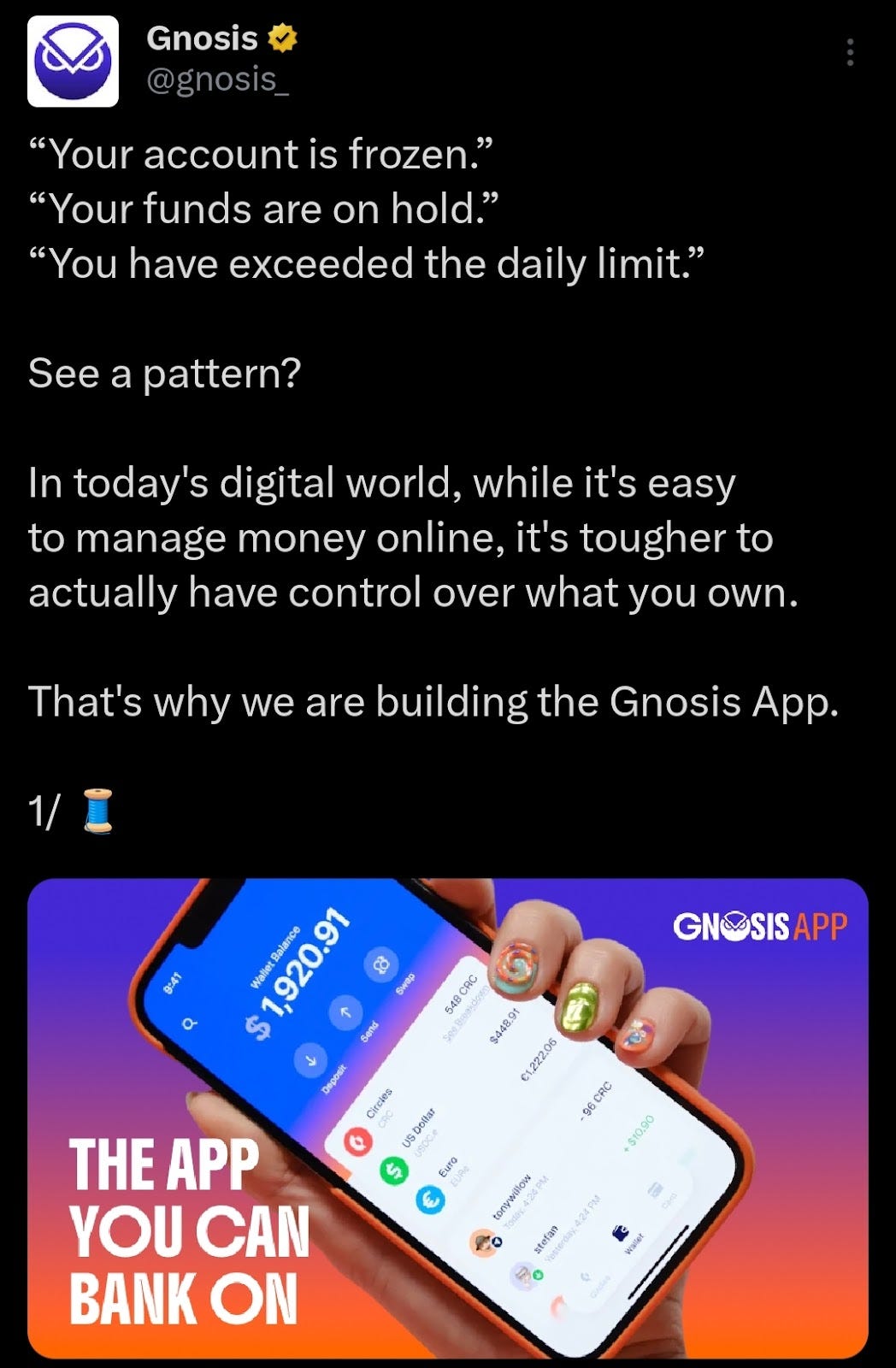
How did they meet the users? By going to where they are.
Gnosis soft‑launched early access of their app to university students in Dublin. Why students?
They're open to experimentation but risk-averse with their money – exactly the tension crypto needs to solve for real adoption.
How to talk to people who don't speak crypto
Before launching, the team did something that is hardly done in web3: they had one-on-one calls with young people and never mentioned crypto. They listened to how students actually thought about money, what frustrated them about banks and what they wanted from financial apps.
They used simple terms like:
Renting your money to banks.
Using versus owning (not custody and self-sovereignty).
What it means to be a product.
The pitch was also simple. Instead of "we built this for you," it was "let's build this together" – to get personalized insights and better shape a product that suits them. The team understood they didn't really know the target audience, so it was best to follow a build-in-public approach for adoption.
The rebrand messaging showed that Gnosis cared
Gnosis’ rebrand leaned into populist language: "Fork banks – give power back to the people."
They communicated the problem they're solving without mentioning decentralized finance infrastructure or permissionless protocols.
Just a clear enemy (banks) and a clear promise (power).
The initial value prop had a direct message + emotional angle.
Direct message : “Get up to 5% cashback”.
Emotional angle : “...because owners always get more and you're an owner in our stack”.
For those interested in going deeper, Gnosis provided resources answering questions like:
What does ownership actually mean?
How is Gnosis' approach different?
How does profit flow without middlemen?
Points are baseless
Over time, we've seen 'brilliant' marketing strategies in the web3 ecosystem reduced to the points system – where streaks, transactions or some sort of activity builds your points and makes you qualified for some reward. That's one of the extrinsic factors that drives behaviour in most crypto apps.
However, the best apps have utility and understand how to design a long-term valuable points system.
Well, Gnosis did something different. Instead of gamifying speculation, they gamified trust.
How?
Gnosis introduced Circle – social money built on trust – where you can mint your own money, retain custody, spend it, send it, use it – not as a store of value like digital gold, but as actual money.
The gamification wasn't "farm more tokens." It was "who do you trust?" Your trust score grows when trustworthy people in the ecosystem trust you. You get invitations based on your trust network.
How is this different from points?
Points are not transferable but Circle is. It practicalises the marketing value proposition of “owning” or “control”.
Side Note
When point systems really work
Not all points are baseless. Some actually drive real behavior when designed with intention.
Take Hyperliquid for example. After five months of invite-only access, they opened referral codes only to users who had done $10,000+ in volume. Each code offered a 4% discount on trading fees.
️ Referral is powerful especially when tailored to get quality users.
Then they (Hyperliquid) launched a six-month points campaign distributing one million points weekly to active users. By week 26, Hyperliquid had become the largest perp dex by volume, open interest and daily active users.
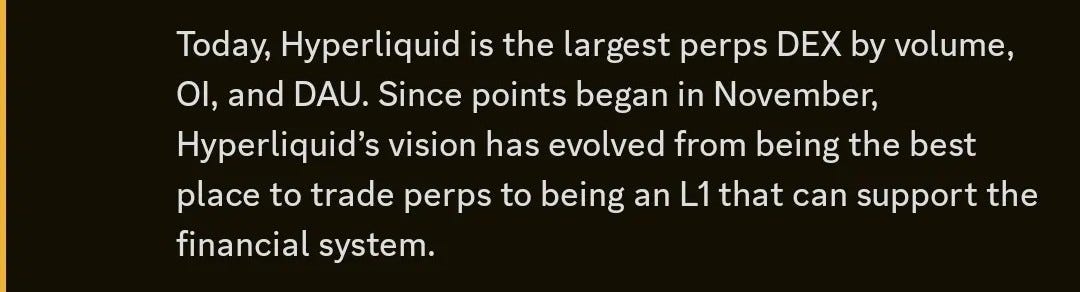
Hyperliquid didn't reward passive farming. They rewarded actual product usage.
Read about Hyperliquid's complete marketing strategy here
When marketing to those who just want things to work, you must get your messaging right…
…Or you lose them.
Gnosis leaned into understanding web2 consumer apps before drafting their copy and creating designs. If they hadn't, they would've clearly assumed everyone is interested in crypto, used crypto jargon to approach the students, and would have gotten turned down.
Another example is a client I recently had a discussion with. These guys built a mobile application that lets users move stablecoins across currencies, chains, and wallets as easily as sending a message. From our conversation, I found out they already have traction from two target audiences – freelancers in emerging countries who need to receive payment in dollars from their clients, and degens. But the freelancers are more.
They intend to increase their traction, and I told them:
Pay more attention to the freelancers who make up the larger chunk of your users.
Your website copy says "making stablecoin payments easy." The truth is many freelancers are web2 native and have no idea what stablecoins are. So rather than that, make sure your messaging speaks directly to them.
Instead of "making stablecoin payments easy," say: "Receive international payments instantly. No bank fees, no delays.
A freelancer doesn't need to know it's running on stablecoins. They just need to know they're getting paid faster.
Meet them where they are.
Use SEO with search terms they'd actually type into Google: "how to receive international payments," "get paid in USD without a US bank account," "avoid PayPal fees for freelancers," "instant payment for remote workers."
Use X to check what freelancers are talking about – search for tweets like "clients won't pay me," "PayPal fees eating my income," "waiting 5 days for payment," "freelancing payment problems." These are your pain points in their own words.
Some prefer to watch videos on Instagram, TikTok, or YouTube. Build an internal community of creators to lower costs and make more impact–help your users become affiliates who create content showing how they get paid faster and keep more money.
Create simple direct messaging for web3 users.
"Save gas fees by moving your stablecoins across chains in seconds without bridging.”
This clearly communicates their problem and the solution. The initial copy they had is bland. Not even a crypto native will easily understand “stablecoins made easy”. The next question would be “how?”
Another strategy I recommended for them is to focus on building a desktop browser extension to enable easy access for degens. Degens don't want another app – they just want to toggle easily from their browser while they're already trading, managing wallets, or aping into new tokens.
Action plans for you
Don't assume non-crypto natives understand the app you're marketing.
You need to go outside crypto twitter and touch grass. Go out there and talk to people about the app you're marketing. Don't explain anything. Find out what they think about the problem the app was meant to solve.
Go back to the drawing board and cut down technical jargon. Audit your messaging. Speak directly to your target audience.
There's no better time to build for mass adoption than during the bear market, when the noise is low. If the product you're marketing for is only relevant during the bull season, then you need to evaluate your long-term goals in the ecosystem.
Web3 marketing stories are boring BUT NOT HERE!
Need help with creating your brand story? Send me an email or a DM on X .