
I dug into Hyperliquid’s growth strategy so you don’t have to.
Thanks for reading Web3tales ! Subscribe for free to receive new posts and support my work.
Contents
Hyperliquid’s first gtm campaign
Hyperliquid’s testnet launch
Hyperliquid’s mainnet alpha launch
Hyperliquid’s TGE
Hyperliquid’s first physical event
Made with love from Web3talez .PS: If you’re a marketer, there are special keys highlighted in between various campaigns for you to pick inspiration from. So look out for this “️” while reading. Enjoy
Growth happens when you’re delivering enough value for people to stick around. It’s quicker to tell marketers to “grow a brand like X or Y”, without first understanding how X or Y actually arrived at growth.
In just under two years after launch, Hyperliquid has taken over roughly 70-80% of the on-chain perps market, pushing over $6.7 billion in daily trading volume and reaching up to $320 billion in monthly transactions. It now ranks as the largest on-chain perps exchange by a wide margin, processing over $1.5 trillion in trading volume over the past year.
In a broader context, Hyperliquid accounts for about 12% of Binance’s perpetual futures volume.
Did all this happen in just two years by shitposting, fighting for mindshare, or focusing on building a product people actually want? This case study captures all the strategies from Hyperliquid’s testnet and mainnet launches, leading up to TGE and beyond.
Product Vision
On December 29, 2022, the team behind the defunct crypto market‑making firm – Chameleon Trading introduced Hyperliquid as the “new home to trade perps on DeFi.” At the time, the space was already dominated by players like GMX and dYdX. Their vision was to:
Build an order book perpetual futures DEX on its own layer 1 chain that does everything CEXs does for perps, but stays fully decentralized.
Ensure the layer 1 chain is high performance - purpose‑built for order books, enabling liquidity providers to precisely control risk, achieve capital efficiency, and support 20,000 orders per second with near instant confirmations.
Implement advanced trading tools, including take profit/stop loss orders, isolated and cross margin, and order modifications directly from TradingView charts.
Allow users to trade on 20+ assets (a figure that has since grown to over 130 perpetual assets) with up to 50× leverage.
Keep transaction costs low with gas fees under $0.001 per transaction to guard against network abuse.
Adopt a competitive fee structure: start with zero trading fees, and later introduce token linked trading fees and maker rebates to remain competitive with top centralized exchanges.
Guarantee transparency and self‑custody, offering the CEX-like experience without the risks of centralized custodians by keeping all operations fully on‑chain and auditable.
Early GTM – Testnet
Paper trading competition
The first GTM campaign was a one‑week $7,500 reward pool trading competition, inviting users to trade at no cost for a chance to win.
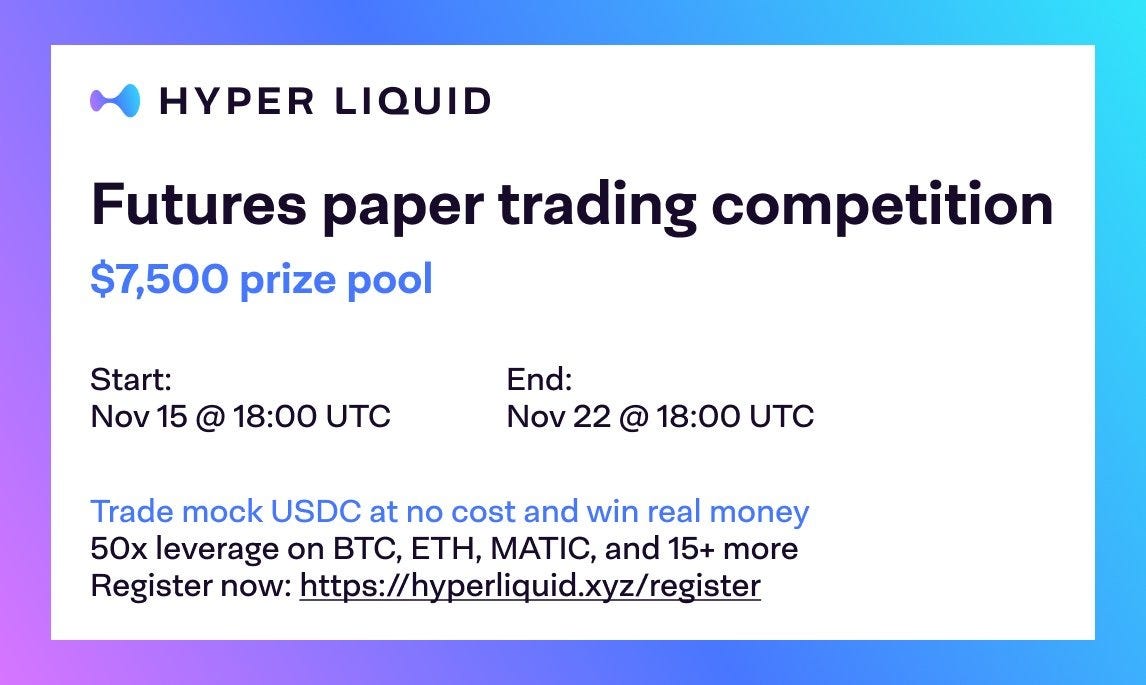
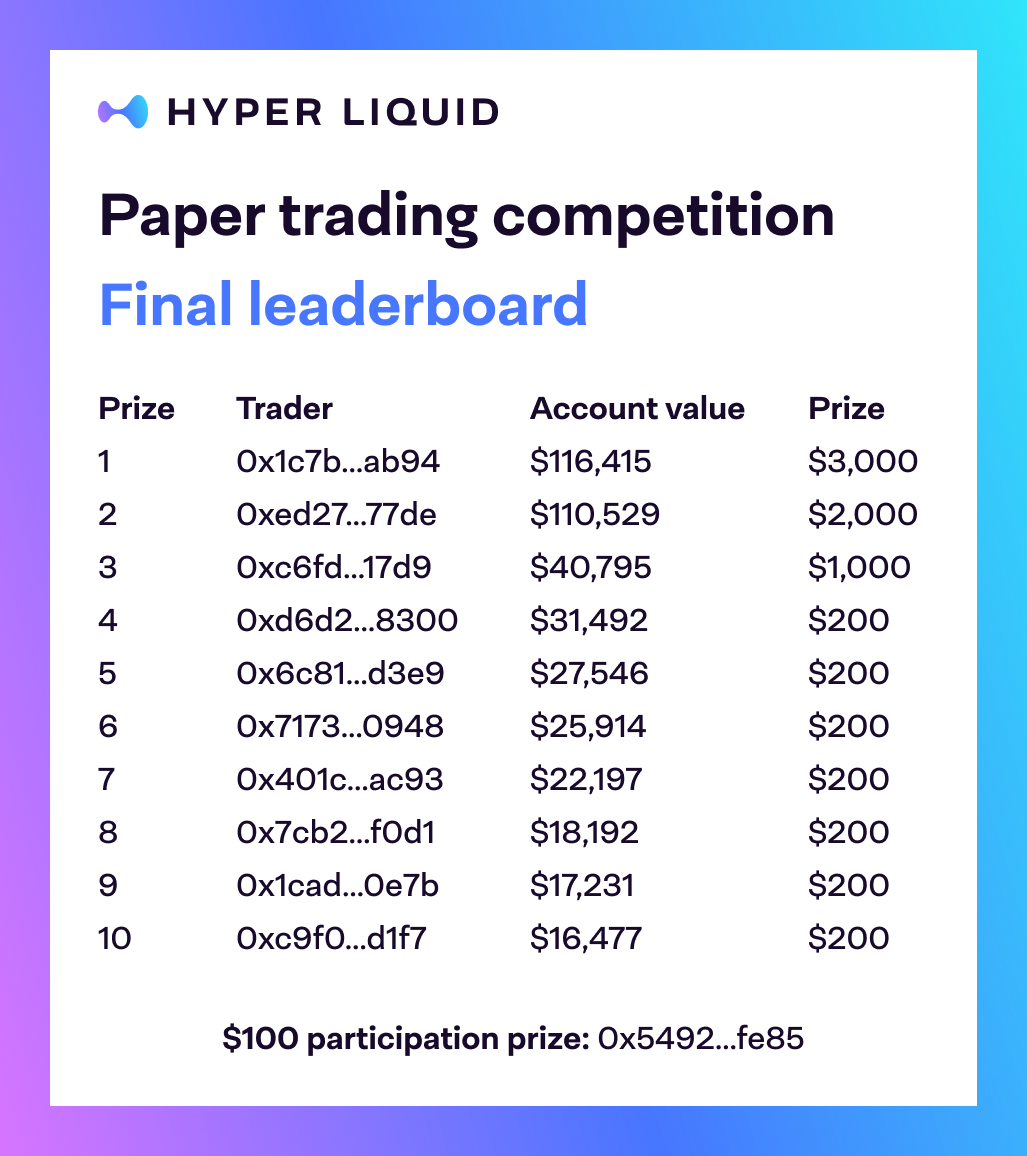
A leaderboard ranking was created to show the top 10 traders with the highest final account balances, who then became eligible for the main rewards, while one additional participant outside the leaderboard received $100 as a participation prize.
By the second day of the competition, 200 traders had joined to compete for the reward pool.
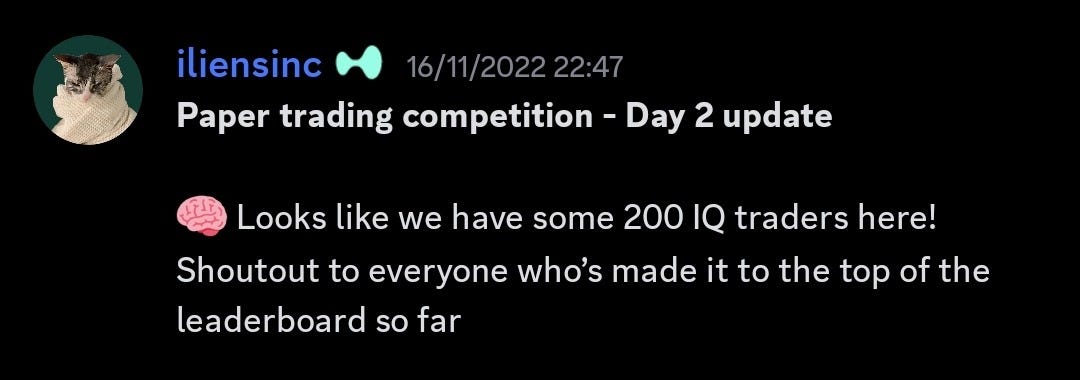
Psychological effect of the paper trading competition:
It was a smart way to build brand awareness and get the first users comfortable experimenting in a mock-up perps trading environment.
It removed the fear of participants incurring losses, thereby increasing the barrier of entry.
Having 11 winners gave every participant a reason to stay active.
Creating a public leaderboard fueled more competition and activity - this is one way you could create buzz on your platform.
️: Creating awareness efforts should be rightly funnelled into traction depending on whatever stage the product is at.The final leaderboard after 7 days
While the paper trading competition was ongoing, the team used it as an opportunity to recognize early adopters by creating an “OG role” in their Discord server for:
Participants in the paper trading competition.
Accounts older than 30 days that followed them on Twitter.
Users who engaged meaningfully in Hyperliquid’s conversations (beyond just posting “gm”).
At this point, anticipation was high. Following the success of the paper trading competition, the team:
Gathered community feedback on new features.
Rebranded from Hyper Liquid to Hyperliquid based on community demand.
Teased on the upcoming testnet launch and urged community members to stay active to secure OG roles.
Side Note
Using $7,500 for a testnet paper trading competition as your first GTM campaign is a bold move and the format targeted the right people – actual traders, not those who merely wanted a reward. Most projects would rather start with something cheaper like a Discord giveaway or a Twitter campaign based on their budget.
For the level of engagement, $7,500 divided among 11 winners with more than 200 participants was efficient. Compare it to:
A typical KOL campaign: $10k to $50k for posts that drive low quality traffic.
Paid ads: Can burn $7,500 in a month with weak targeting.
Conference sponsorships: $25k or more for a booth that doesn't end up converting at the end of the day.
Testnet L1 launch
A month after the paper trading competition, the team launched a new testnet on their standalone Tendermint-based blockchain. The earlier competition had been hosted on Arbitrum Goerli, a testing network that lets devs and users try features without using real funds.
They announced that the testnet would run for one month and encouraged users to stay active, as only active participants would be whitelisted for early access to the mainnet launch, which they called mainnet closed alpha (more on this later).
While testnet L1 was live, more campaigns were run to boost visibility and traction
A Twitter Space was held in collaboration with Rekt Gang to discuss Hyperliquid’s vision, L1 testnet progress, and product roadmap. To drive attendance, the team announced that a Trippy Wolf nft would be given to one lucky listener who joined.
Eight days later, a week-long liquidation contest was announced where traders who were liquidated (had their positions automatically closed due to losses), entered into a raffle where five winners received 50 USDC each, with multiple entries allowed for repeated liquidations. The user with the fastest liquidation, measured by the time from opening a position to being liquidated, won a Trippy Wolf nft.
Psychological effect of the liquidation contest
️: Own your narrative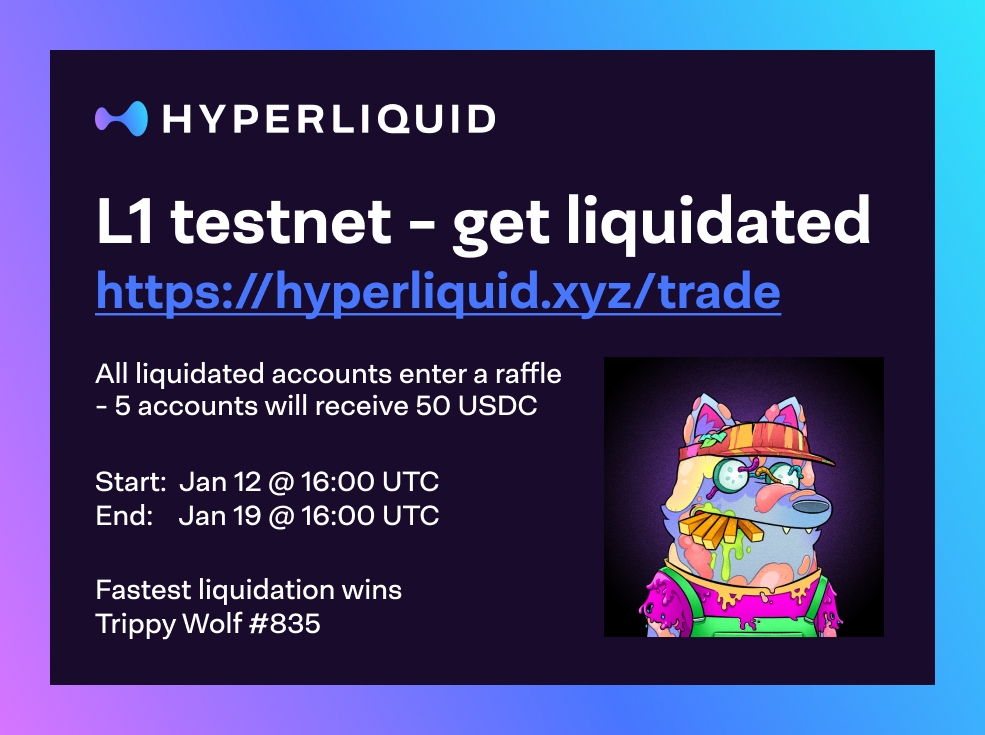
The campaign turned losses into fun by framing liquidation as a game. Allowing multiple raffle entries for repeated liquidations motivated participants to engage more often, thereby increasing platform activity. Also, the aim was to inculcate a habit - good products drive behaviour. By getting liquidated on testnet the Hyperliquid team believed that the traders would then become pros at not getting liquidated when mainnet launches. So it was a free platform for trial and error.

Still on L1 testnet, a 200 USDC prize pool was announced to be set aside for three randomly selected testnet participants at the end of the testing phase.
Another Twitter Space was organised by the team to discuss order book exchanges and dex.
Hyperliquid around that time launched strategy pools, a feature that allows anyone to create or join a pool that follows a trading strategy. Pool leaders earned a share of profits while participants could back strategies without trading themselves. This added a social and collaborative layer to the testnet experience and showcased the platform’s flexibility ahead of mainnet.
They did not just announce the launch of strategy pools. They built a campaign around it, using the new feature to drive user engagement through a community trading competition called DAO Wars.
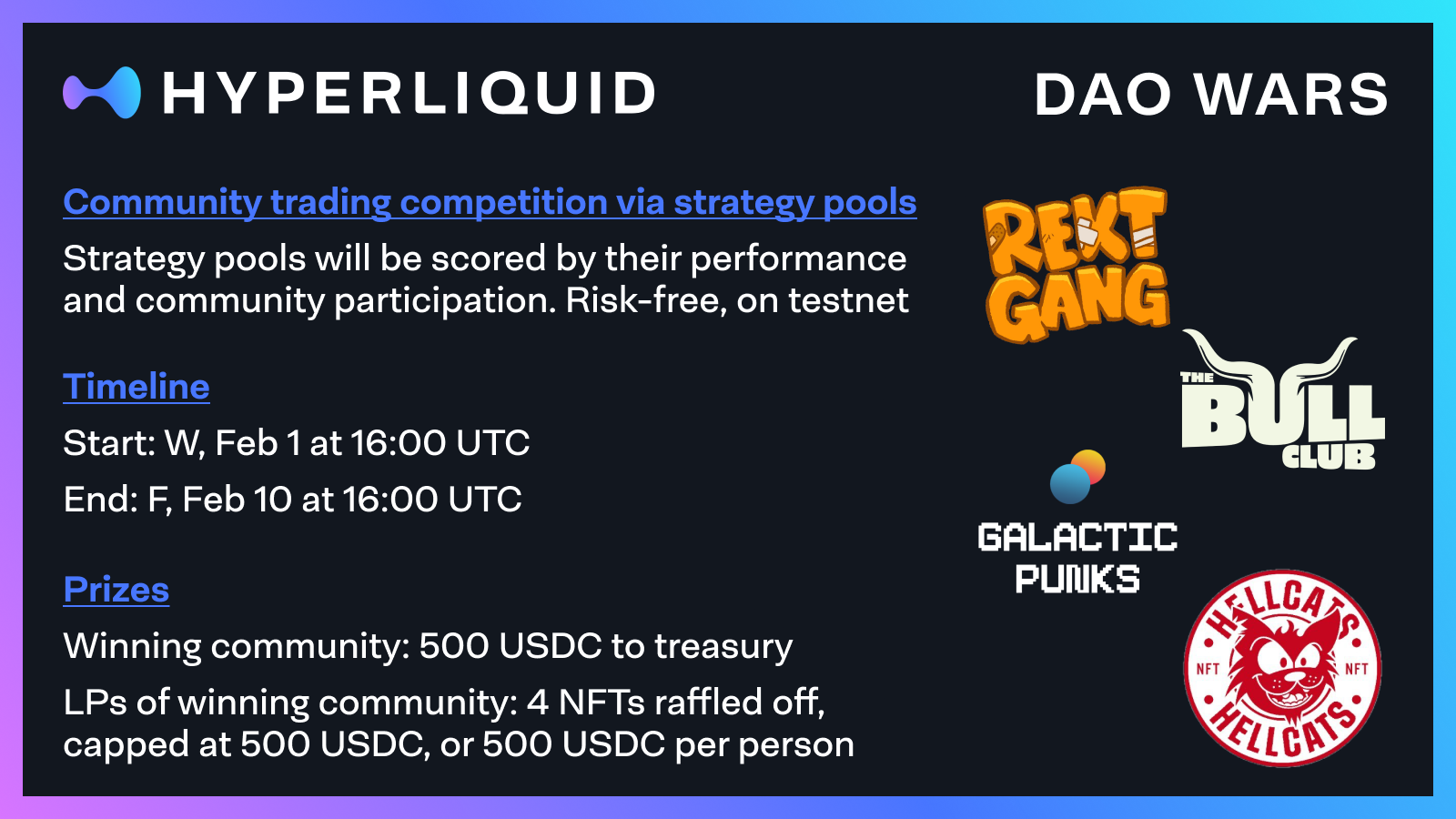
In simple terms, DAO Wars turned the launch into a game which they framed as a battle between communities. Each group chose a representative to execute all trades, while members backed them with liquidity. Other activities for the contest involved sharing posts on Twitter and Discord.
Bear in mind that the contest was held on testnet, so there was no financial risk, but the prizes were real. With $2,500 up for grabs, six DAO communities competed. Hyperliquid also reset balances and limited faucet rewards to keep the playing field fair. This made testing feel fun and competitive rather than just another feature release.
️: Don’t just dump a post to announce a new feature, be creative about driving traction.The preparation for DAO Wars competition was followed by a Twitter space and an article discussing best strategies players can use to win the contest.
Competition Structure
The contest measured two things:
1. Community engagement - activity in Discord, shared content on Twitter, and memes.
2. Trading performance - profits, liquidity, and strategy execution and duplicate accounts were cut out to keep it fair.
From this contest, users were able to push testnet liquidity above $100k in TVL. This is a feat that many protocols struggle to attain but Hyperliquid through community engagement had already started seeing such numbers on testnet.
Mainnet Alpha Launch
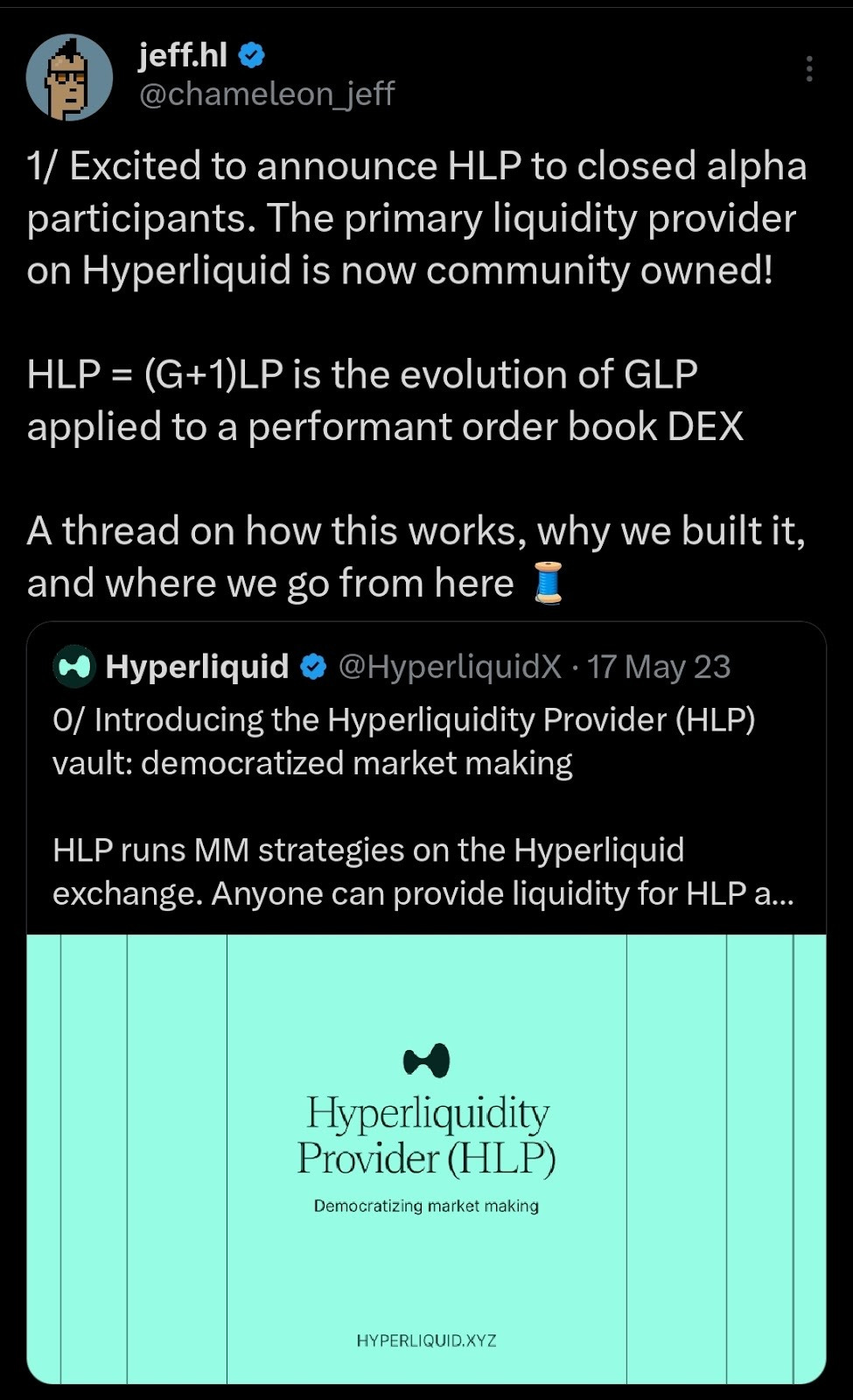
About 10 days after gaining more momentum from the DAO Wars contest, Hyperliquid announced a mainnet alpha launch - this was the first version of the platform on mainnet with exclusive access to only whitelisted users and those who later completed a Zealy quest. For better communication, a separate Discord channel was created for whitelisted users to use the platform and send in feedback while those without access continued trading on the testnet.In this phase, two strategies were key:
Exclusivity: Hyperliquid was able to build more anticipation through exclusivity. Exclusivity doesn’t mean giving access to KOLs but the people that matter - the community members - those who had rallied around the project for about a year before mainnet launch. When it comes to building a strong community, KOLs don’t matter; they help you rent attention whereas you can own it yourself.
Further reading: KOL marketing is dead. Do this instead.
️: If 90% of your community members are onlookers it’s either you don’t have a product or you’re targeting the wrong people.Founder funnel : The exact month that the mainnet alpha was announced, Hyperliquid’s CEO created his X account, which became an additional marketing channel by amplifying posts from the brand’s official account, while also building his own authority by framing a narrative around the pain points Hyperliquid aimed to solve in the future.
️: For anyone who thinks giveaways are enough to build a brand, remember this: in Web3, people want to buy from people. Also, brand accounts have been proven over time to have lesser reach than personal accounts.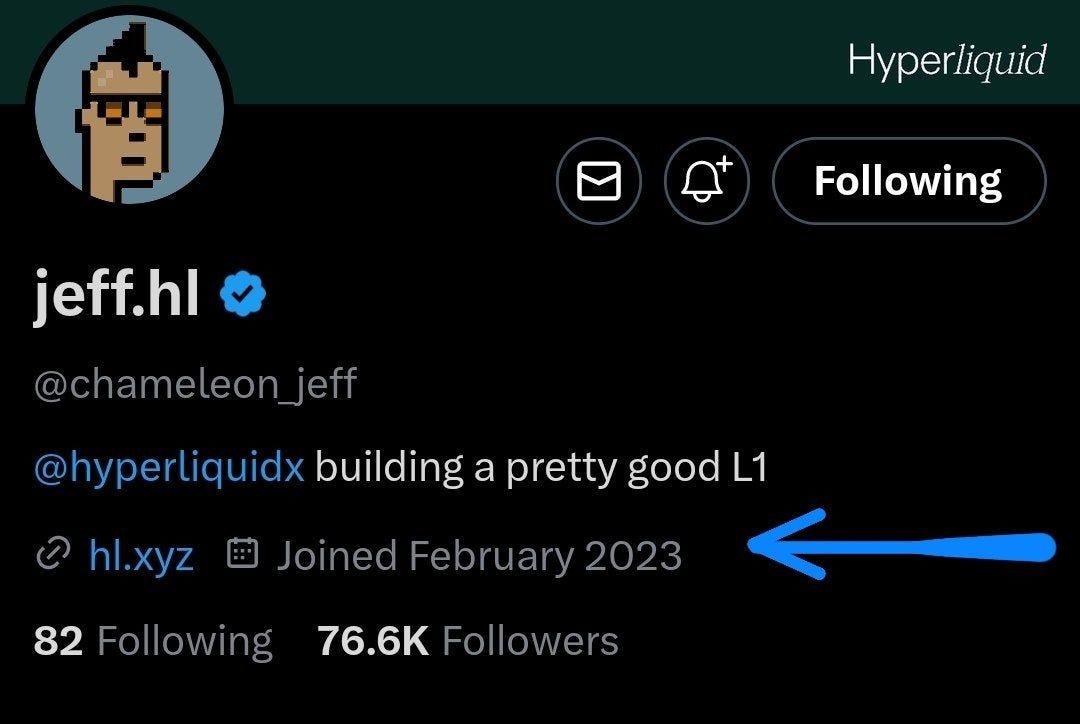
Activities following mainnet alpha launch
More feature updates like additional market pairs and UI redesign.
Referral pilot: Users who traded $100 or more on the mainnet alpha were given the opportunity to create a referral code, which could be used up to three times per week.
A scoring system was set based on trading volume and referrals.
Reward pool: For every $10,000 in exchange volume, $1 was added to the reward pool, with a guaranteed minimum of $1,000 distributed weekly to top scorers.
User’s score = Trading volume + 50% of referral volume.
User’s rewards = (User’s score ÷ Total scores) x Reward pool
By the third week of referral pilot, rewards were distributed to 81 addresses who collectively traded $9.25m in volume.
Psychology behind referral program
Community loop : Only users who traded $100 or more could create referral codes and win from the reward pool. The idea was to reward those who added liquidity and growth, not passive members. This prevented a referral program that would bring in low-quality users who refer but never actually use the platform.
More activities followed the mainnet exclusive launch
Integration with Squid, a cross-chain router.
Jeff joined several spaces and podcasts almost every week to talk about updates, the perp trading ecosystem, and Hyperliquid’s campaigns. He built his reputation as a thought leader by posting long threads on Twitter that answered community questions and explained how Hyperliquid planned to solve them.
️: One of the laws of marketing states that: People are a lot more likely to listen to what a person who is deemed as an authority is saying.Deep dive articles published and shared on X.
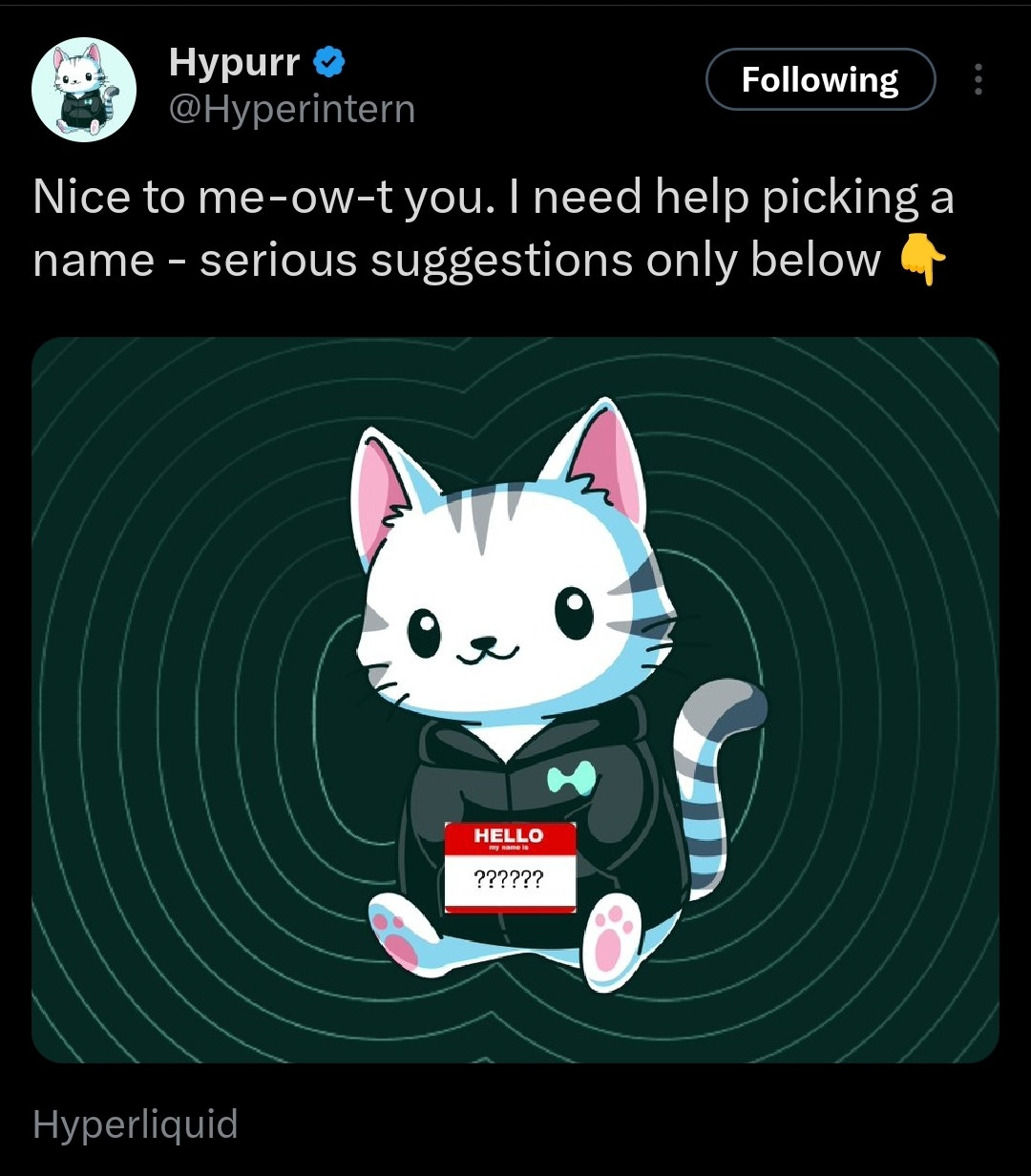
Intern account and mascot launch.
Introduction of more roles and levels on Discord.
Community efforts started kicking off with randomly creating videos on how to use the Hyperliquid API .
P&L contest - A 10-days contest where participants shared their profit and loss positions on Twitter, tagged Hyperliquid, and dropped the tweet link in the community channel. Each user could only submit one entry per asset, and only mainnet trades were valid.
At the end of the contest, the biggest winner and the biggest loser received $69 USDC each, while 6 others received $42 USDC each.
Community calls were held at about one-month intervals, each offering a POAP NFT as an incentive for attending. The only way attendees could mint the proof-of-attendance NFT was by entering a secret code revealed during the call. The minting window lasted just 15 minutes.
️ Create deliberate efforts to make your community members feel seen.The referral program was paused while the team worked on a new setup with taker fees, maker rebates, referrer cuts, and extra incentives. Non-HLP trading volume hit $94M as firms joined organically even in mainnet alpha.
Open interest reward system
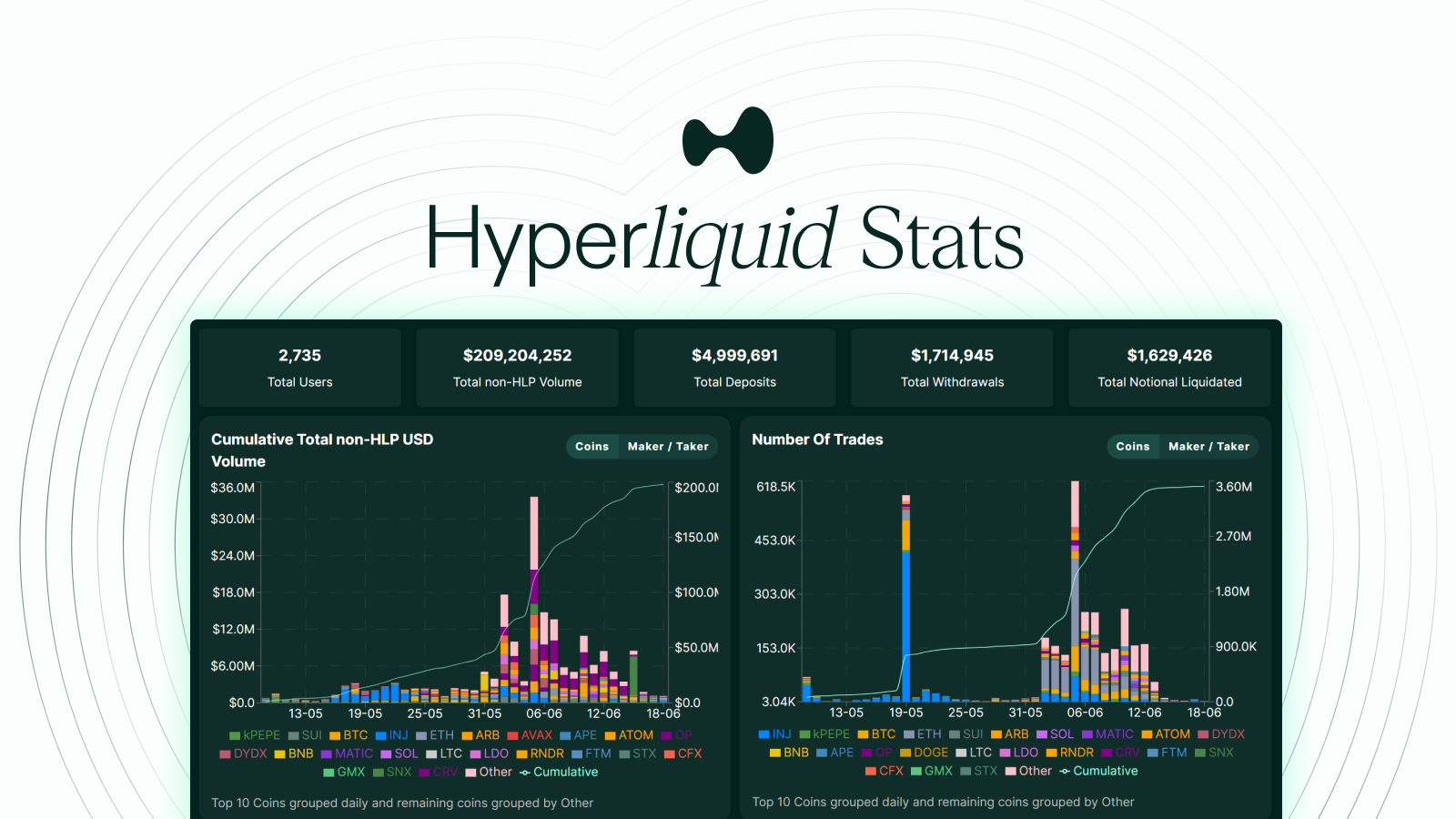
Five months after mainnet alpha, Hyperliquid passed $200M in non-HLP volume with 3.6M+ trades from 2,700+ users. To drive adoption, the team tested the open interest reward campaign that gave traders half of weekly net fees based on their share of open interest. It pushed activity into less traded assets and was a trial run for a model that could later fit into the L1 fee system.
The first week of open interest incentives ended with open interest rising over 70%, from just under $1M to $1.7M. Rewards were set to be calculated and distributed the next day, with the program continuing weekly.
Detective program
To spot bugs, a detective program was opened for mainnet alpha users, with perks like point boosts, a detective role on Discord, and prizes for spotting major issues.
Crisis management
Sometimes in August 2023, YGG price swings caused liquidations. Because oracle prices were used, liquidations here were less aggressive than on other exchanges. Still, the Liquidator vault lost $160k while HLP made $200k. The team shut down the liquidator vault, let users move to HLP, and set up an insurance fund from fees to cover those hit hardest.
Launch of ZRO-USD hyperp, the first Hyperliquid-only perp that allowed users long or short the unlaunched LayerZero token with max 3x leverage on isolated margin.
Moved from using spot price to mark price as liquidation logic.
Post Closed Alpha Launch
Remember at this time, Hyperliquid was only open to a select few who had invite codes. After about five months of invite access only, referral codes became open to every user provided that they had done $10,000 and above in volume. Each code offered a 4% discount on trading fees.
️ : Referral is a powerful funnel, know how to filter it to get quality users.Then a new campaign was introduced:
Points Program: For many people like me who don’t trade perps, this was when I first learned about Hyperliquid - through the points affiliate program. This became a pivotal marketing strategy for Hyperliquid.
The six-month campaign distributed one million points weekly to active users, rewarding both trading activity and affiliates. Affiliates earned one point for every four points their referrals earned. Everything was transparent: a live page was introduced on the website to let users view their results without needing to claim anything.
By week 3 of the campaign, Hyperliquid reached $10B in total volume. Along this period, Jeff jumped on an AMA Sushiswap.
By week 4, Hyperliquid had multiplied traction through the points campaign:
8.8K users earned points
$3.8B volume traded
$36M open interest
$30M notional liquidated
$14M inflow
By week 5, TVL had climbed to $1.4B, up from $840m the previous week.
By week 12, 1m points was distributed to 18k users and a Hypurr sticker pack was added to Telegram and Discord.
By week 15, daily active traders had exceeded 11k while daily volume hit $1.5b.
After exactly 26 weeks of running the campaign, Hyperliquid ended it on 1st May 2024, smashing all records to become the largest perp dex by volume.
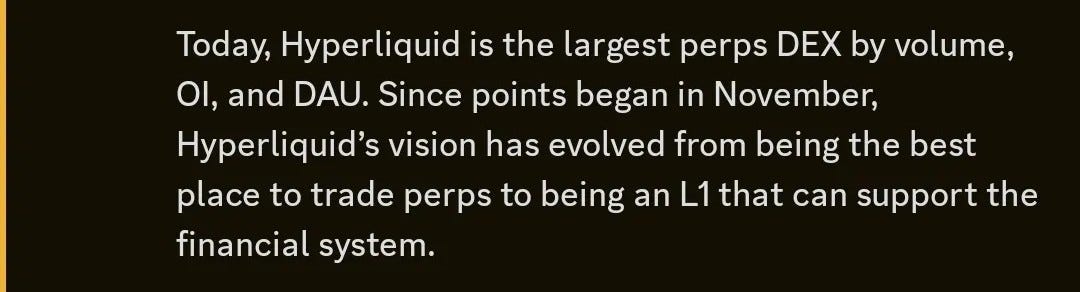
PS: This points campaign didn’t include early-access users. It only covered those who actively traded from November 1, 2023 (when the campaign started). A separate snapshot was taken on October 31, 2023, for a different points drop dedicated to closed alpha users. 4,462,258 points were later distributed to 11.5k closed alpha users for activity before October 31, 2023.
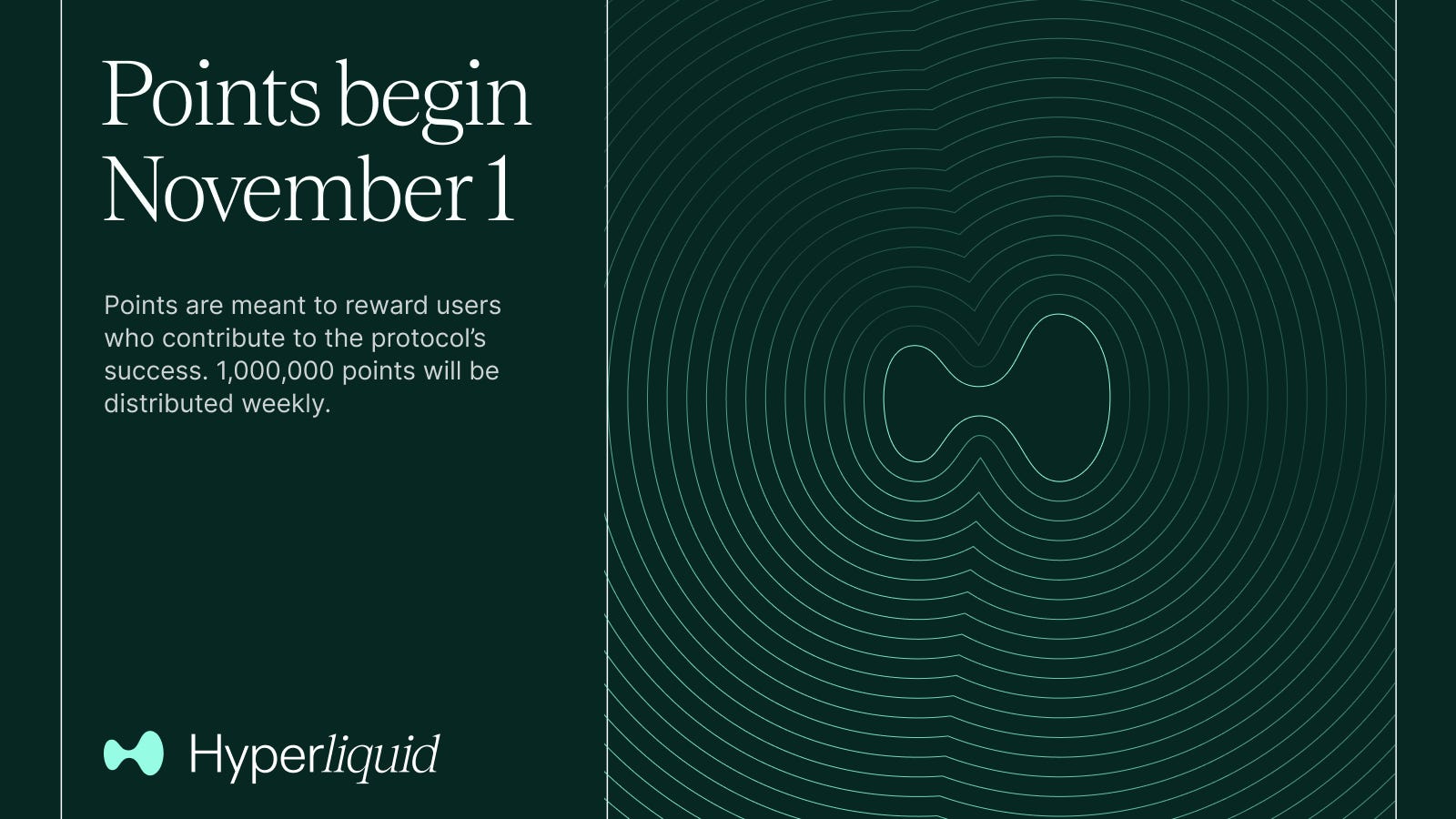
️: Learn how to game points if you’re marketing a DeFi app. Many points systems feel boring because they don’t create any sense of scarcity, so they feel common. Hyperliquid was deliberate about issuing only one million points each week and having users scramble for them. This built the competition that brought in traction.Ecosystem Expansion
Hyperliquid L1 EVM integrationAfter pulling the right strings to become the number one perp dex, Hyperliquid added a native EVM to its L1. The aim was to let developers build with familiar Ethereum tools, while still tapping into Hyperliquid’s high-performance native components. HyperEVM fully went live in February 2025.
️: Growth is a journey not a destination. Build on your efforts of yesterday to lay bricks for today and tomorrow.The EVM integration was followed by Hyperliquid’s foundation launch – Hyper Foundation, to support the growth of Hyperliquid’s ecosystem.
$HYPE LaunchThe next step was the launch of their native token, HYPE, to power the HyperBFT proof of stake system, the HyperEVM, and future features on the roadmap.
L1 points campaign
Yet again, barely four weeks after the previous points campaign ended, Hyperliquid launched another, aiming to encourage users to explore the ecosystem, refer new users, test new features, and drive adoption.
These were the rules of the campaign:
700,000 points were distributed each week for four months.
Activity was tracked weekly, from Thursday to Wednesday and points were sent out every Friday.
Points were awarded based on platform activity, such as trading, staking, or interacting with new L1 features.
Referrers earned 1 point for every 5 points their referrals earned. Affiliates had to reapply each period to qualify
2,000,000 extra points were distributed for activity from May 1–28 (while no point campaign was on) to reward organic traction.
️: Keep an eye on your fans. They return because they trust you, not because of a campaign. Activity may have dropped after the first points campaign, but the team still monitored returning users.By the 10th week of the campaign, Hyperliquid had risen to $4.3b in 24h volume.
First Physical Event
During Token2049 in 2024, Hyperliquid hosted their first offline community event, giving out Hypurr plushies. This was a unique marketing move for a perp DEX – something usually seen in fun or NFT projects like Pudgy. It humanized the brand and strengthened community bonds. At the same time, it acted as a social strategy: photos and videos of the plushies and event spread organically across social channels, reinforced Hyperliquid’s fun personality and identity.

️: Offline events work best once you’ve built an online community. Spending on merch at a crypto event just for fun doesn’t convert anyone and has no clear target audience.TGE
There’s no perfect TGE. No matter how much you try, some people will still feel under-allocated. Hyperliquid’s TGE is one of the rare cases that people point to as part of the top one percent of TGEs that was well planned and here’s why:
31 % of HYPE supply (≈ 310 million tokens) was distributed to early adopters via a points‑based airdrop.
Core contributors received 23.8 % of supply, but all tokens were subject to vesting schedules to ensure long-term alignment.
No public allocations were made to VCs or external investors, keeping the focus on the community.
The TGE followed a clear, transparent structure with pre-announced rules and distribution schedules.
Future rewards and grant allocations were clearly defined, this gave the community members visibility into long-term incentives.
Post-TGE, HYPE reached an all-time high of ~$59 in September 2025 but is currently trading around $30–$31, with a market cap of ~$8.4 billion.
The initial airdrop is done. About 38.88% of the supply sits in the pool for future community rewards and emissions. Season 2 farming is running through trading, staking, and HyperEVM activity. More rewards can come from that pool depending on how the team chooses to release it.
The sequential timeline of events:
Genesis Airdrop Registration Deadline (November 11, 2024)
Hyperliquid prepared the genesis distribution for eligible users. Early participants also received Hypurr NFTs tied to the event. Staking went live soon after and a large share of the supply moved into staking during the first phase.
TGE and Airdrop Distribution (November 29, 2024 at 07:30 UTC)
About 310 million HYPE was distributed during the TGE. Eligible users could claim through the Hyperliquid dashboard. Trading also opened with the HYPE USDC pair.
A year later …
By the end of 2024, compared to 2023, the results were staggering:
24h ATH volume grew from $1B to $15B (15x)
Open interest grew from $178M to $4.3B (24x)
TVL grew from $56M to $2.1B (37x)
Users grew from 31k to 300k (9x)
Markets expanded from 100 perps to 158 perps and 128 native spot assets
24h revenue from trading fees and spot auctions passed $3.5M
Post TGE
By Q1 2025, Hyperliquid reached $1 trillion in trading volume, becoming the first decentralized exchange to rival CEXs in scale.
In March, Hyperliquid introduced staking tiers, where the amount of HYPE staked determined fee discounts. The main goal was lower trading fees, with the update going live after April 30 to give users time to adjust.
In May 2025, they launched a staking referral program. Builders and referrers who staked HYPE could earn a portion of trading fees from users they brought in, up to 40% for those at the highest staking tier. They could also share part of this revenue with referred users, improving incentives.
️ : As you grow, don’t forget that you always have to treat your users right.Still in May 2025, the team engaged with the U.S. Commodity Futures Trading Commission (CFTC) by submitting comment letters on perpetual derivatives and 24/7 trading.
️ : Being proactive with regulators shows users you care about their protection.In September 2025:
Hinted at launching a native stablecoin by opening a community vote on the USDH ticker.
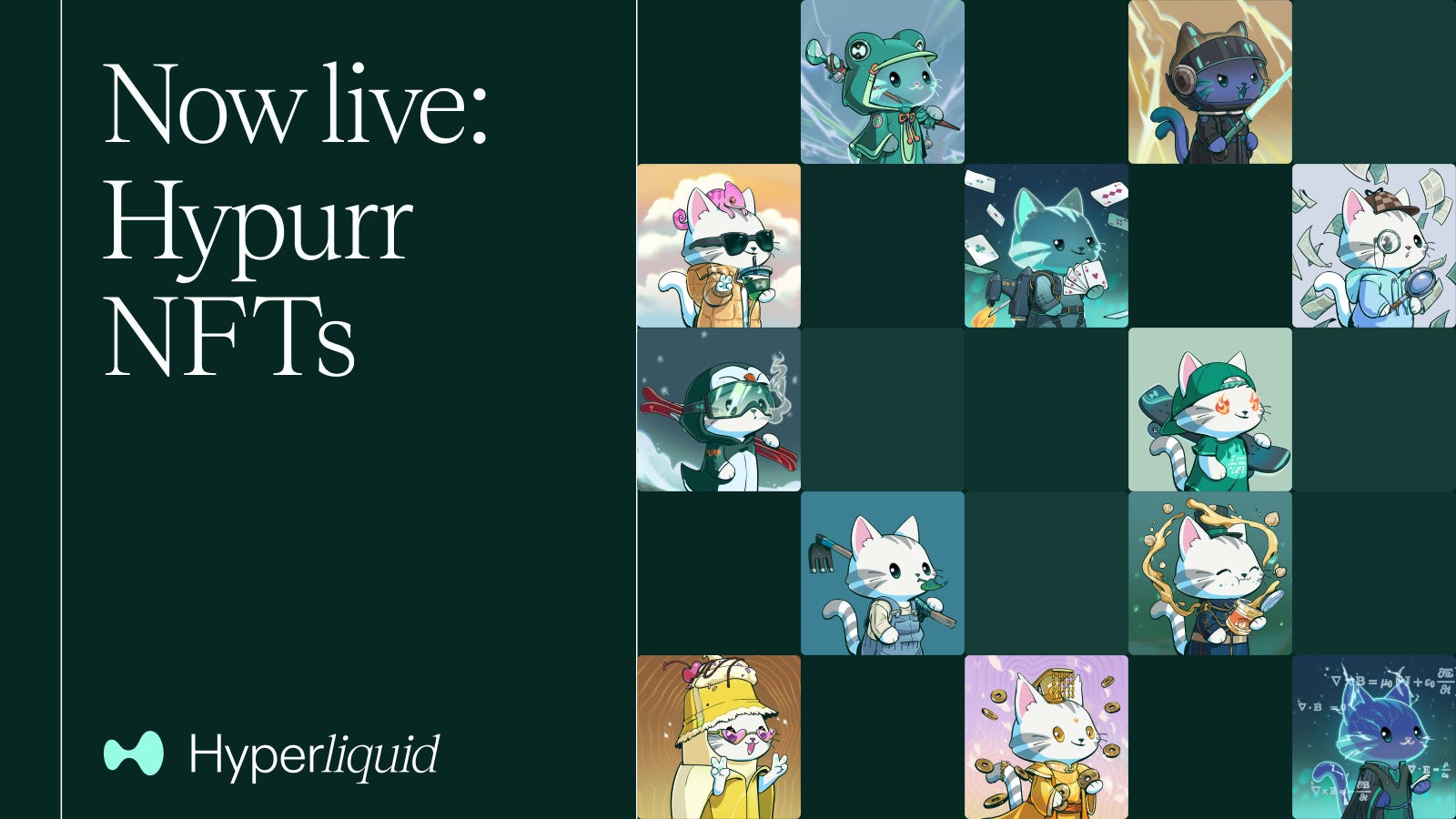
The 4,600-piece Hypurr NFT collection was minted for early contributors, serving as both a reward and a tradable digital collectible, with the floor price reaching nearly $70,000 for a single NFT.
2025 Wins (compared to 2024):
24h Volume: $32B, up from $15B in 2024
Open interest: $16B, up from $4B in 2024
TVL: $6B, up from $2B in 2024
24h protocol revenue: $20M, up from $3.5M in 2024
Users: 1.4M, up from 300k in 2024
Web3 marketing stories are boring BUT NOT HERE!
Need help with creating your brand story? Send me an email, or maybe a DM here on newsletter or a DM on LinkedIn
Thanks for reading Web3tales ! Subscribe for free to receive new posts and support my work.