


Early last year when prediction markets started becoming a thing, I had the opportunity of managing research and GTM for a prediction market on Solana.

At the time I discovered there were at least 50+ prediction markets and discovered Yes/No markets wouldn’t be a criterion to stand out or gain liquidity, so I forged this product with infinite growth loops.

Unfortunately the product got hacked at V1 and the team moved on to other things, but I decided to share this with you to help you with ideas when positioning, differentiating and marketing for mass adoption especially when there are many competitors in the field playing the same game.

Enjoy!
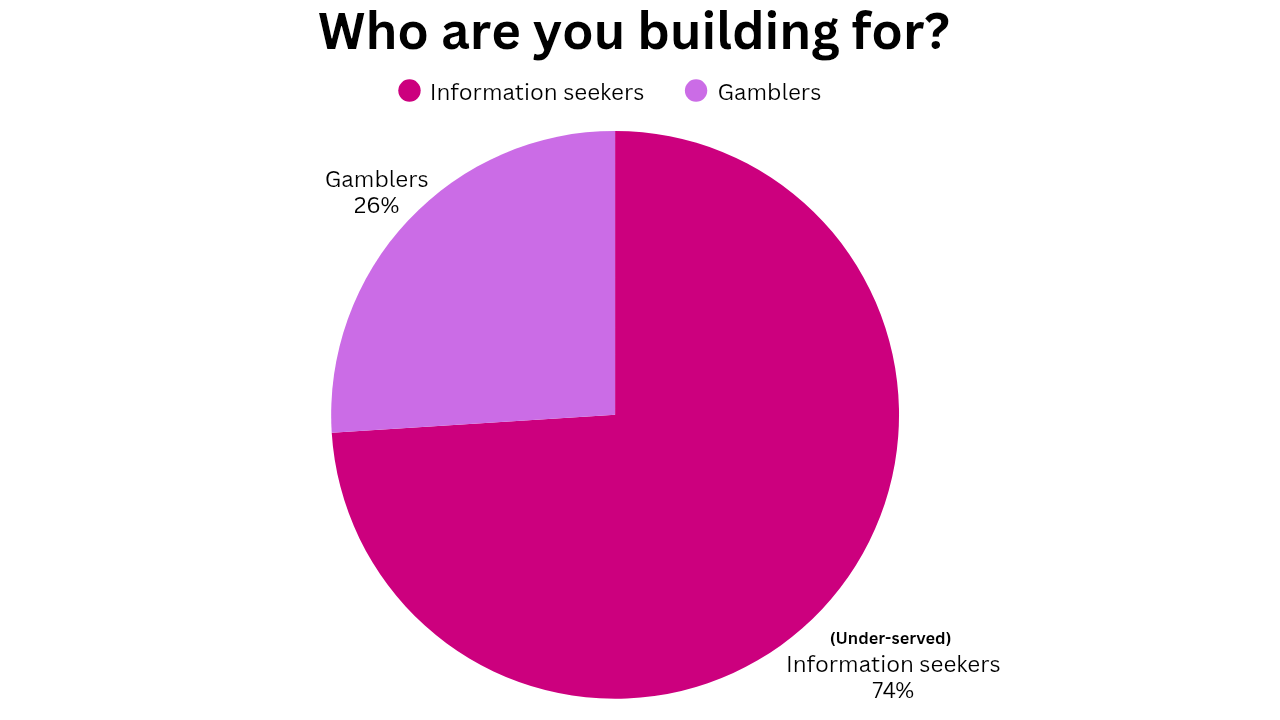
Recent data suggests 26% of the world’s population is into gambling.
What about the remaining 74%? They would rather have information than risk their last card. It’s the exact reason why doom scrolling is a thing – on X, on Reddit, on Instagram, on Facebook, you name it. You just keep scrolling to know what’s happening or, in some cases, what will happen.
Not everyone wants to put their money where their mouth is, as brandished.
The surge of prediction markets that began in 2024 polished this assumption. But if you look clearly, it’s far from the truth.
Prediction markets as they are now have distorted the view of what “truth” is by birthing an autocratic internet where people manufacture truth. It has become a place where you’re not predicting – you’re forcing your opinion to become truth. And in this era of short-form content gaining more virality, fake news travels faster and truth gets punished.
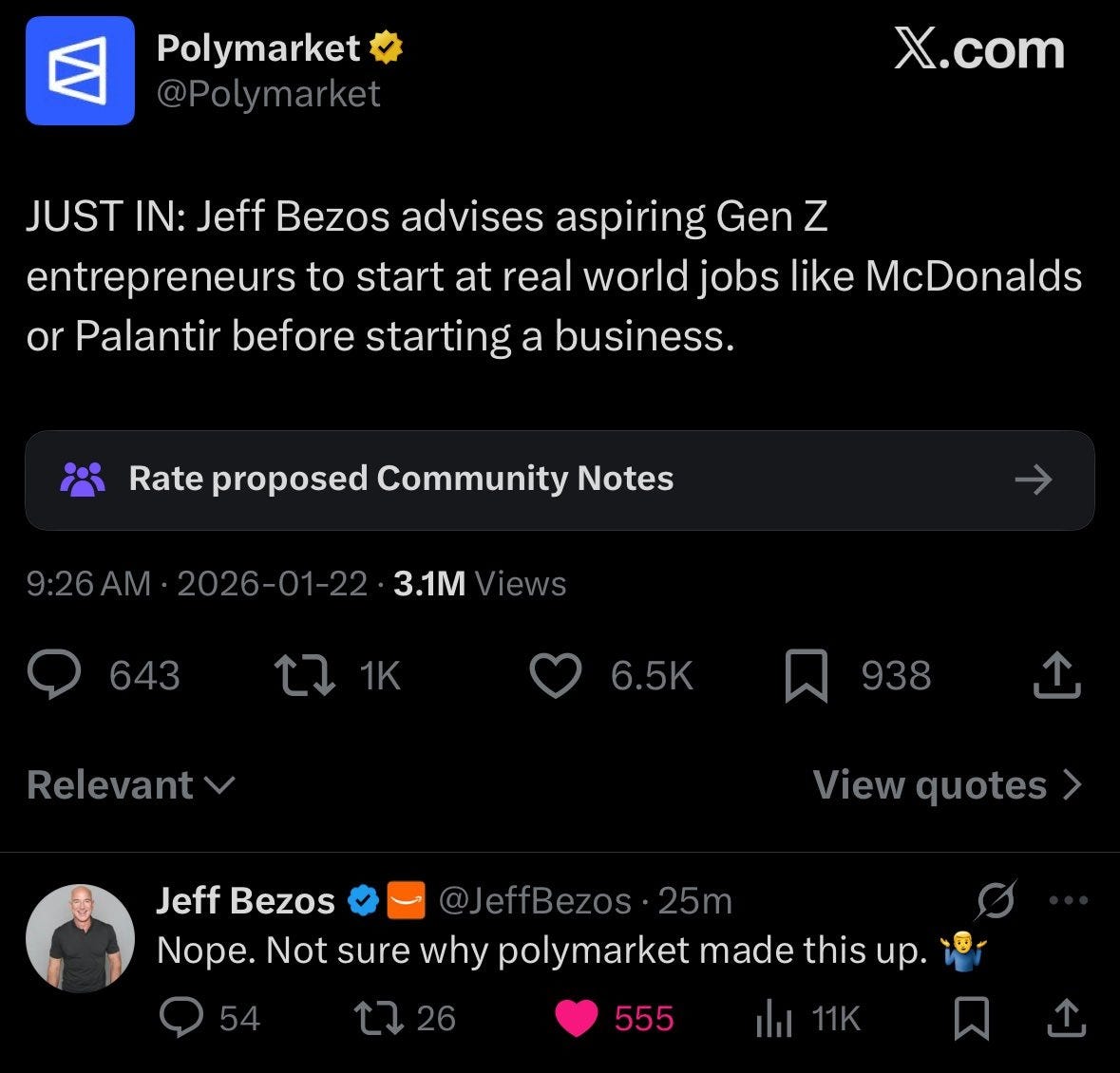
A decentralized internet should do the opposite. It should reward people for being right, not for being loud. It should make truth verifiable, not profitable to manipulate.
Insider trading is ruthless
Robin Hanson, acclaimed as the godfather of modern prediction markets, thinks insider trading is a feature, not a bug. “People with more information should trade more and get more money because that’s how they get paid for the information they contribute.”
Polymarket’s founder Shayne Coplan agrees. He calls insider trading a “public good” that gives the masses access to accurate information faster.
Sounds cool? Maybe, but there’s a problem:
When truth becomes profitable, people don’t seek truth, they manufacture it.
The problem isn’t that prediction markets reward deep pockets with bigger payouts – the math is actually fair. A $1 bet can win $90,000 if you’re right and everyone else is wrong.
The problem is that people with insider information, access to influence networks, and the ability to coordinate sentiment have an unfair advantage. They can:
Spread rumors that move markets
Leak false “insider info” to trade on
Coordinate pumps on certain outcomes
Afford to be wrong repeatedly without consequence
The 74% who don’t gamble just want information and not to trade it. They want an archive of predictions over time to help them make decisions. They want clarity. They want to know which airline is most likely to delay flights by an hour.
So when Hanson says “you should only trade if you have information,” it automatically gives insiders god status to make money off everyone else’s risk. This further ruins crypto’s public image, especially at this critical time when the market is red. Why would anyone even want to build here?
Normies just want information at their finger tips as simple as checking their weather app. A prediction market could make this a reality if the game glorifies truth over gambling.
At least Kalshi understands how brutal insider trading is
Their founder put it this way:
“Insider trading erodes trust. When people believe a market is unfair, they stop trading. Liquidity dries up, volume collapses, and the market dies.”
Kalshi built an entire surveillance apparatus. They have a system called Poirot that flags suspicious patterns in real-time. They run over 200 investigations a year. They’ve brought in Wharton forensic analytics experts, partnered with institutional-grade monitoring tools, formed an independent surveillance audit committee and also hired a “Head of Enforcement” who’s a self-proclaimed “financial crime nerd.”
All of this just to police insider trading.
But here’s the thing: Kalshi is centralized.
Do normies care about centralisation or decentralisation if something just works?
Well, if humans have full control over markets, user funds and settlement processes, the entire process denies users the “freedom” crypto promises not just that, abuse by these humans is inevitable.
Prediction markets → Information Markets
There are too many prediction markets struggling for the same liquidity.
An information market with prediction as a side feature will seduce the masses into participating either as onlookers or active stakers.
Start by not calling it a prediction market. Call it an information market. Because “prediction market” sounds like betting, and that turns a lot of people off.
For the sake of this product expository, an information market is a combination of both prediction and opinion markets.
Stay with me.
An information market should be a place where crowd-sourced knowledge gets verified and archived to build a track record of truth and at the same time, a place where opinions are weighed to decipher truth.
But the difference is not just in the name change but how it should function. At its core, it should be about helping people make smart decisions based on a history of accurate information over time. In an information market, people should be rewarded for being right, not just lucky.
When you scroll Reddit or Quora, you’re looking for answers from people who actually know. So think of this as a decentralized Quora or Reddit, but one that spotlights those with accurate predictions over time, archives all predictions under various categories for people to discover truths and patterns, rewards everyone, and becomes the single platform for finding truth.
The last time I checked, there were over 50 teams building prediction markets with the same Yes/No staking feature. Nothing about this is enticing to the masses – not claims of global access, deeper liquidity on major events, peer-to-peer trading, faster blockchain-based market creation and settlement, lower or zero fees with high APY rewards, unique categories like AI-integrated or NFT-linked markets, higher claimed accuracy over polls, wider entertainment and sports coverage including conditional or mention-based events, or permissionless market creation for anyone.
Most of these “advantages” show they’re marketing to the same audience and struggling for the same liquidity captured by major players like Polymarket and Kalshi.
Who will information markets make sense to?
The 74% who check Yelp reviews but never write one, read Reddit but don’t post, use Google Maps but don’t add photos.
How an information market should work
In an information market, not every question should be staked. For instance, a person asks: "Can schizophrenia be cured?"
And then experts lay out their knowledge on the matter in the comments - psychiatrists, researchers, people living with the condition, caregivers share their experience.
Here, the value is in the quality of answers, ranked by:
The expertise of the person answering (verified credentials, track record in medical predictions).
Community upvotes weighted by accuracy scores
The depth and sources cited in the response
However, if someone in the comments makes a testable claim - “A new schizophrenia treatment will be FDA-approved by 2028” - that could become a stakeable sub-market.
Not everything needs skin in the game. But when someone makes a claim about the future, the platform can ask: "Want to stake on this?"
This is how you serve both the 74% who just want reliable information AND create markets where appropriate. Medical questions. Travel advice. Restaurant recommendations. Career guidance. Most of these are information requests, not prediction opportunities.
But when predictions emerge naturally from the discussion, they get tracked.
This is the flexibility current prediction markets don't have. They force everything into a yes/no bet. An information market lets the content breathe - and only creates markets where they actually make sense.
In an information market, markets get created in two ways:
AI auto-creates from the internet
The platform scans news sources and social media : Reuters, Bloomberg, Twitter, Reddit, TikTok, looking for claims about the future.
If someone tweets: “Apple will release a foldable iPhone by June 2027.” and a news outlet reports: “Analysts predict Bitcoin will hit $150k by year-end.”
AI automatically:
Creates a market for each claim
Tracks who made the original prediction
Lets the community stake their position
Resolves it when the time comes using verified data.
The original source gets their accuracy tracked publicly and onchain.
Users create markets by asking questions – as is obtainable in some prediction markets today.
But here’s where it gets interesting… with opinion markets.
Not everything is black and white. Some questions are subjective.
“Who’s the GOAT : Messi vs Ronaldo?”
In a traditional prediction market, this doesn’t work. There’s no objective answer.
But in an information market, you can create layered markets with criteria.
Main market: “Messi vs Ronaldo – who’s the GOAT?”
But you define the criteria:
By skill (subjective, crowd consensus)
By trophies won (objective, AI-verifiable)
By global fanbase (objective, measurable data)
By cultural impact (mix of data + opinions)
People stake on their choice AND the criteria that matters most to them. Some markets will resolve objectively (AI checks trophy counts, follower numbers).
Other markets will resolve by crowd consensus after a set period. Markets like this could have long-term staking with the option for users to pull out at any time. So it becomes an investment decision.
With this, you’re just making a prediction, you’re taking a position you believe in enough to hold long-term. But if the crowd sentiment shifts and you change your mind, you can exit.
Your entry and exit points get tracked. And when the market finally resolves, your accuracy at that specific timeframe gets recorded.
This automatically creates a market where:
Short-term traders can hop in and out
Long-term believers can hold their position
Everyone’s timing and conviction gets scored
Normies can just check the current consensus without participating.
Either way, your prediction and opinion gets tracked. Your accuracy in that market category builds your reputation.
The comment section becomes a market
This is where it gets even more interesting because this could become a more engaging social media platform.
Every market will have a discussion thread where people debate, share research, and make arguments. But unlike Reddit or Quora, comments will not just be opinions. They can become markets themselves based on democratic criteria like engagement.
For instance, with this market: “Messi vs Ronaldo – who’s the GOAT?”, sub-markets can exist from the comment section like: “Messi will win another Ballon d’Or before Ronaldo retires.”
How this will cater for all parties involved
For normies, it’s simple: Just upvote comments you agree with. See badges next to names (Grand Seer means this person knows their stuff). Comments will be ranked by engagement + track record of accuracy.
For traders: Put money on specific comment predictions by trading on sub-markets that emerge from discussions.
In summary, every interaction becomes a market and normies don’t need to understand the complexity. They just see: “This comment has 847 upvotes and comes from a Grand Seer with 94% accuracy in sports predictions.” So they trust it, upvote and move on.
How an information market can prevent insider trading
Unlike traditional prediction markets, this reputation system will make insider trading unprofitable. Here's how:
Require Grand Seers to prove accuracy across unrelated domains like tech, elections, and sports.
If a user repeatedly bets huge portions of their money on unlikely outcomes that keep winning, the AI flags this suspicious pattern because normal forecasters spread their risk and sometimes lose big.
Top stakers must publicly explain their reasoning before markets close, this creates a trap where insiders either expose themselves by saying too much or lose credibility by being suspiciously vague.
Retroactively downgrade predictions if someone gets exposed as an insider later. If a user is later discovered to be an insider, all their past predictions in that category get downgraded and their reputation score recalculates, meaning they could lose years of built-up status in one exposure.
Create markets requiring multiple related predictions simultaneously.
Let the community vote on whether flagged patterns are insider trading or legitimate skill.
AI as oracle
AI will be the impartial oracle to resolve prediction markets and use crowd consensus to resolve opinion markets.
Everything gets archived and searchable
This is what turns it into an information market, not just a betting platform. Every closed market stays searchable forever. Someone in 2050 can search: “California summer travel” and find:
markets from previous years with crowd predictions
discussion threads with insights and data
accuracy rates of who predicted what
verified outcomes from AI resolution
patterns over multiple years
In summary, it becomes a knowledge repository that gets more valuable over time. Unlike betting platforms that ghost town between events, this becomes more useful the longer it exists.
Reputation system
Users get tracked based on two things:
Pathfinder score
If you ask clear, important, resolvable questions and your markets spark valuable discussions, you earn this score.
Seer Score (prediction accuracy)
If your predictions are correct you earn points in addition to stakes. Every wrong prediction loses you points. Your accuracy rate is public, permanent and on-chain.
As a predictor, you earn ranks as you progress.
Over time, you unlock ranks:
Grand seer (elite category)- visionary leaders with strong foresight.
Seer - top predictors with a track record of accuracy.
Pathfinder - users with a strong balance of insightful questions.
Onlookers - users who observe but never ask or answer questions.
Curious - newcomers yet to ask or answer questions.
Growth loop
Reputation becomes one of the major growth loops.
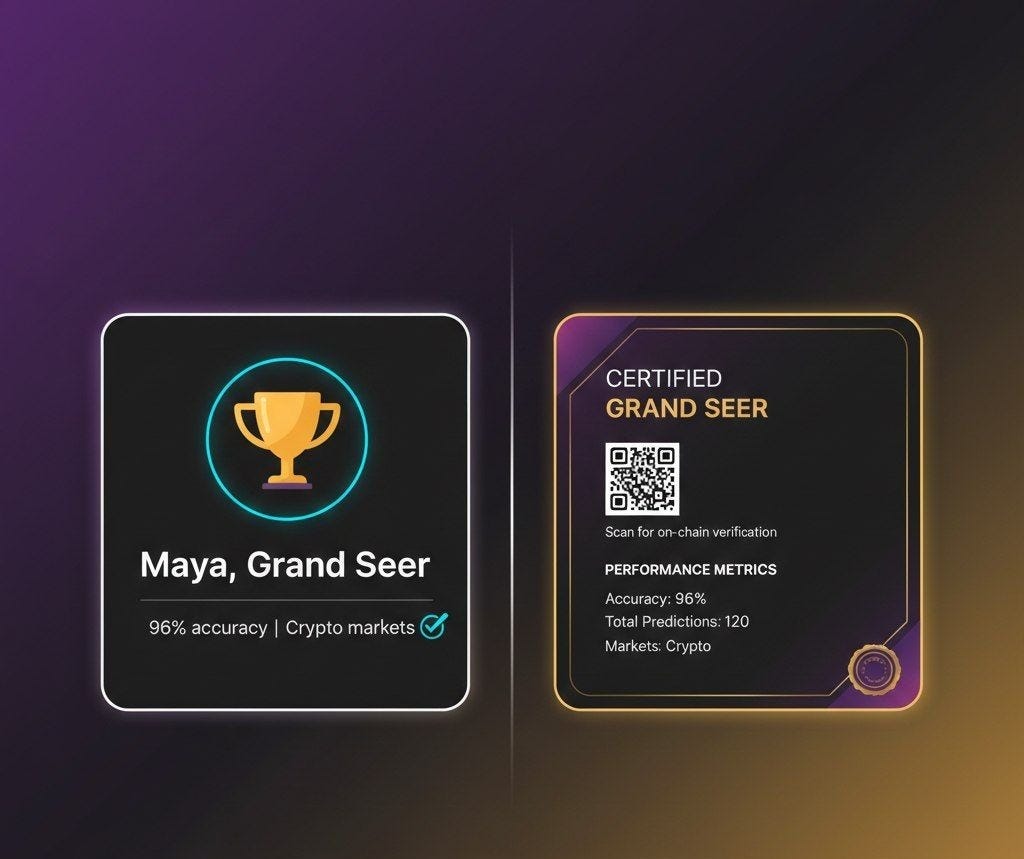
Unlike a self-proclaimed “expert” or “analyst,” your accuracy is publicly verifiable on-chain.
Anyone can click your profile and see:
Every prediction you’ve made
Your accuracy rate over time
Which niches you dominate
Where you’ve been wrong
How you compare to others
This could become bigger. Tech companies could hire Grand Seers as advisors. VCs could check founders’ prediction scores before investing. Media could cite Seers instead of random pundits. Podcasts could intro guests by their rank and accuracy.
Your track record becomes a reputation you can’t buy or fake.You can only earn it by being consistently right.
The marketing brilliance behind information markets
The product features and information markets category naming removes the gambling or betting stigma and invites more participation.
While 50+ prediction markets are marketing to the same group of people, with an information market, it has a bigger advantage by capturing the 74% who just want information. So the competitors are bigger players like Reddit, Google and Quora.
It captures human behaviour. There are more readers than traders online.
Making accuracy scores portable and verifiable creates network effects.
Archiving prediction insights and making them searchable historical records transforms the product from entertainment to infrastructure for decision-making.
The prediction market for mass adoption hasn’t been built yet... But this is the blueprint.
Who’s building this?