
In this case study:
Which institutional crypto companies make AI’s shortlist most often?
Does appearing in an answer mean being the first recommendation?
Do ChatGPT and Gemini choose the same providers?
Which companies lead individual institutional crypto categories?
What changes when questions involve pricing or alternatives?
Whose websites get cited, and what are those pages publishing?
What kind of contents should an institutional crypto company make based on the analysed data?
Let’s get right into it!
Suppose you’re looking out for a crypto infrastructure for your business and turn to ChatGPT or Gemini for recommendations.
Depending on the problem you’re trying to solve, the results might look like this. For example, if you’re:
A Head of Digital Assets at a large bank looking for institutional crypto custody: Anchorage Digital, Fireblocks or BitGo.
A Compliance Officer at a crypto exchange searching for blockchain analytics and AML solutions: Chainalysis or Elliptic.
A Payments Lead at a fintech looking for crypto payment infrastructure: BVNK or Bridge.
A Stablecoin Product Manager searching for stablecoin infrastructure: Bridge, BVNK or Circle.
A CTO building blockchain applications looking for blockchain APIs: Alchemy or QuickNode.
An Asset Manager exploring real-world asset tokenization: Securitize.
A Trading Operations Lead looking for institutional trading and settlement infrastructure: Fireblocks or Copper.
These companies appeared repeatedly in my recent experiment of 100 ChatGPT and Gemini answers across 10 institutional crypto categories.
But why do some companies keep getting recommended while others barely appear? Does it come down to product relevance, brand recognition, the content they publish, or what other websites say about them? And when AI recommends a company, does it cite that company’s website?
You’re about to find out.
Which institutional crypto companies does AI recommend most?Of the eight companies reviewed, Fireblocks appeared most often, showing up in 70 out of 90 relevant answers (77.8%).
Copper followed at 68.4%, Anchorage Digital at 47.1%, and Chainalysis at 45.8%. Alchemy and QuickNode each appeared in 37.5% of relevant answers.
These figures only include questions related to the products each company offers.
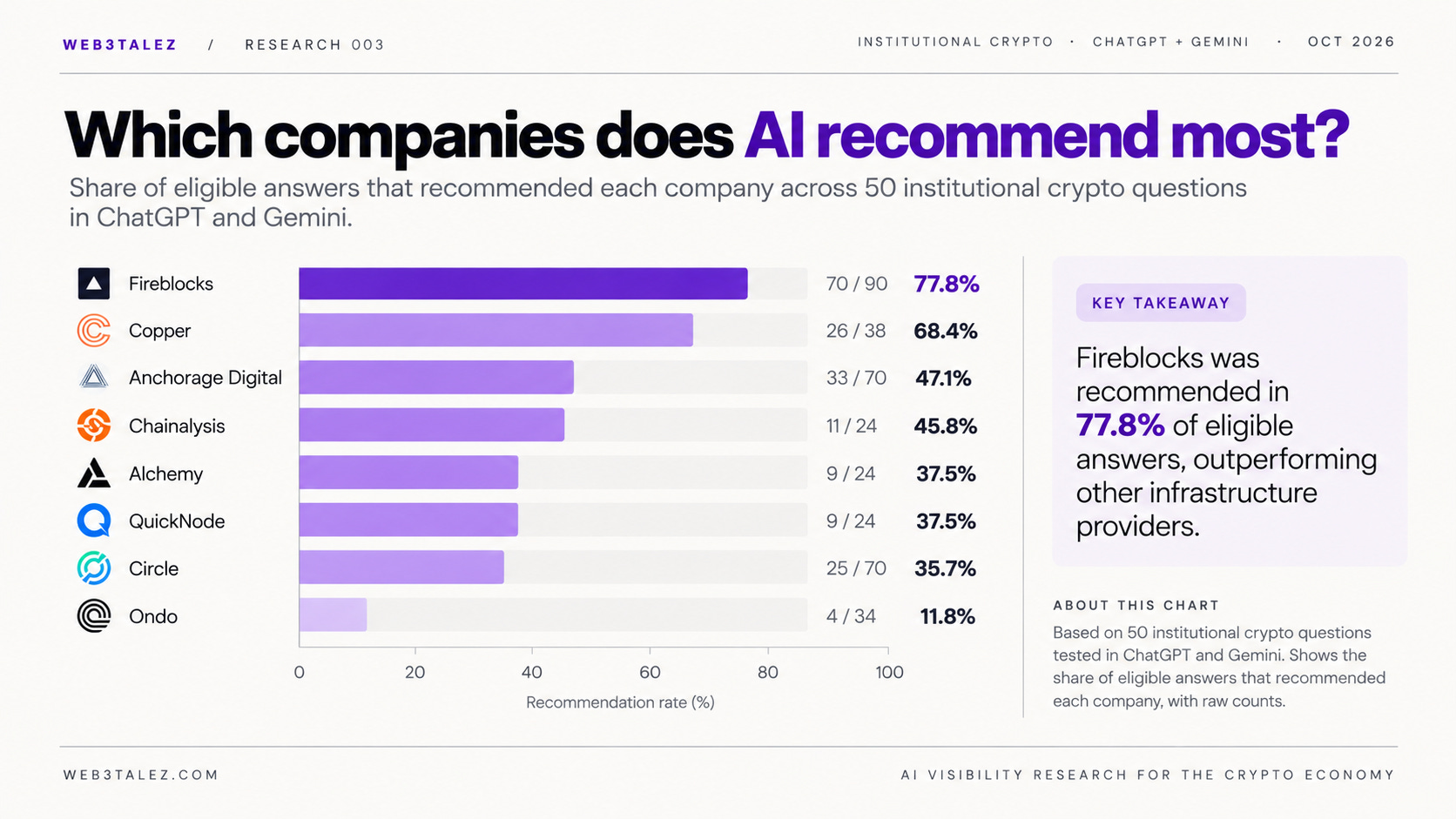
These percentages are based on questions relevant to each company’s products. For example, Chainalysis, which focuses on blockchain analytics and compliance, shouldn’t be expected to appear in answers about blockchain APIs.This shows the companies weren’t all evaluated against the same questions. Some offer products across several categories, while others focus on specific areas.
But being recommended doesn’t necessarily mean being the first choice. To see the difference, we need to look at where each company appears in the answers.
Does making the shortlist mean being the first choice?Not necessarily. Copper was recommended 26 times but ranked first only once among its eligible answers. Chainalysis was recommended 11 times and ranked first eight times. Fireblocks was recommended 70 times and ranked first 23 times.
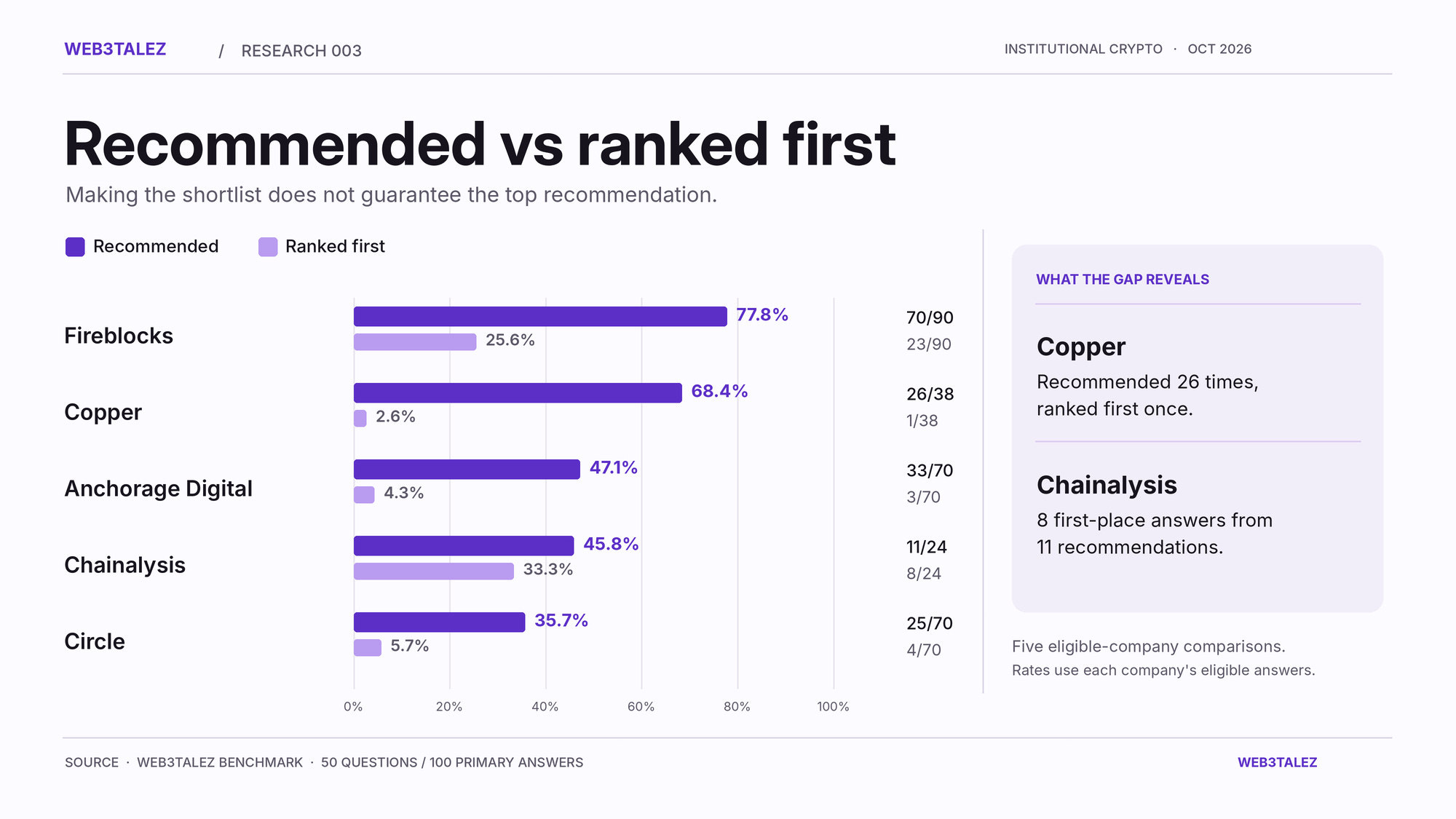
There’s a difference between being recommended and being ranked first. A company might appear regularly as an option without ever being the first choice. And even when AI ranks a company first, that doesn’t necessarily mean it’s the best option for the buyer. That’s why it’s important to measure how often a company gets recommended and how often it comes first.
Do ChatGPT and Gemini make the same recommendations?They overlap, but the order changes.
Across the 50 matched questions, ChatGPT ranked Fireblocks first 16 times, compared with seven for Gemini. Gemini put Ledger Enterprise first seven times, compared with one for ChatGPT. Bridge ranked first six times in each engine
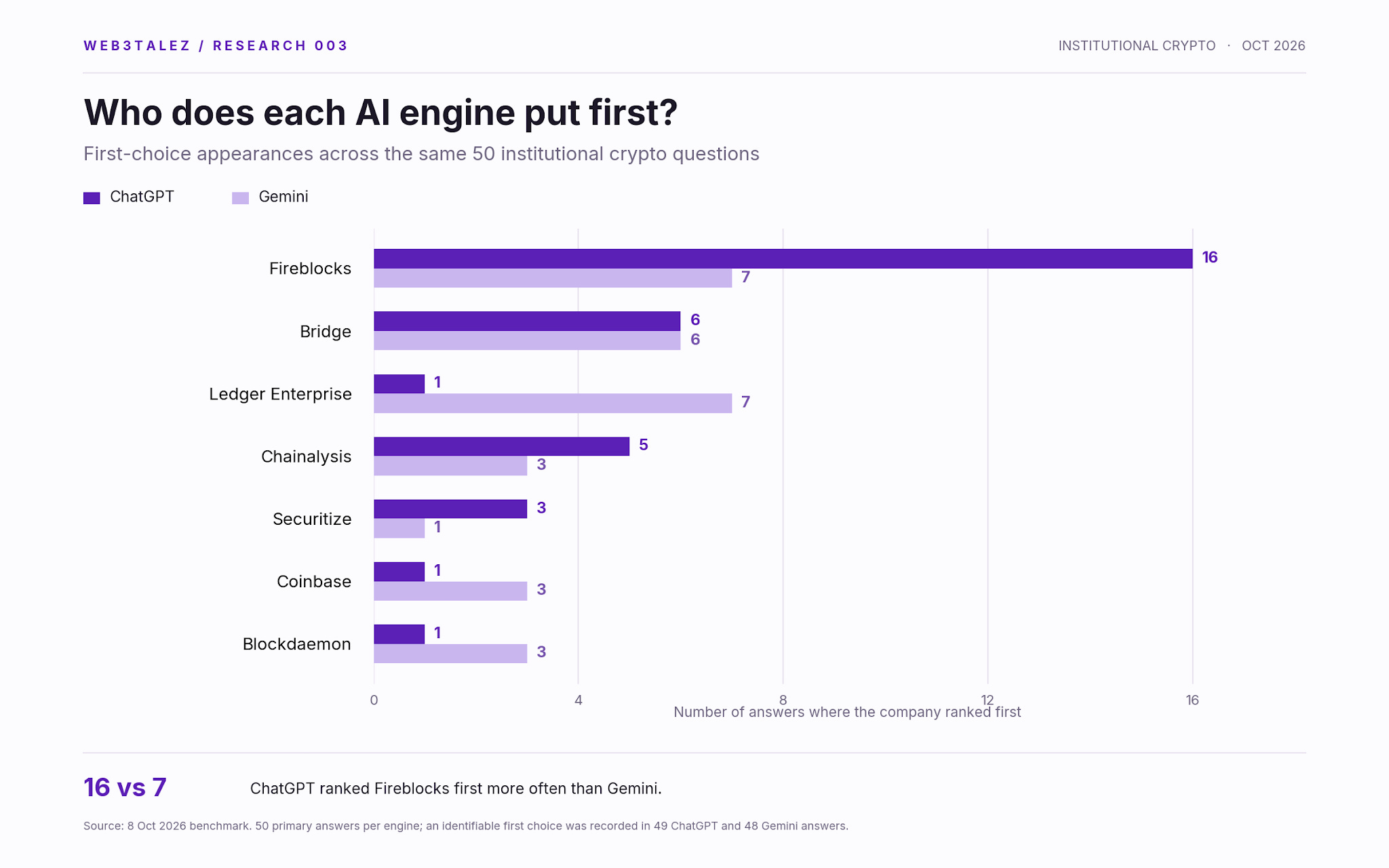
Combining the results from both platforms could hide these differences. A company might rank first frequently on ChatGPT but perform differently on Gemini.
Also, these results are based on tests conducted on a single day. AI recommendations can change over time, so the findings shouldn’t be treated as permanent rankings.
Who does AI recommend for specific crypto infrastructure needs?No single company led every category. The recommendations changed depending on whether the question was about custody, compliance, payments, or blockchain APIs.
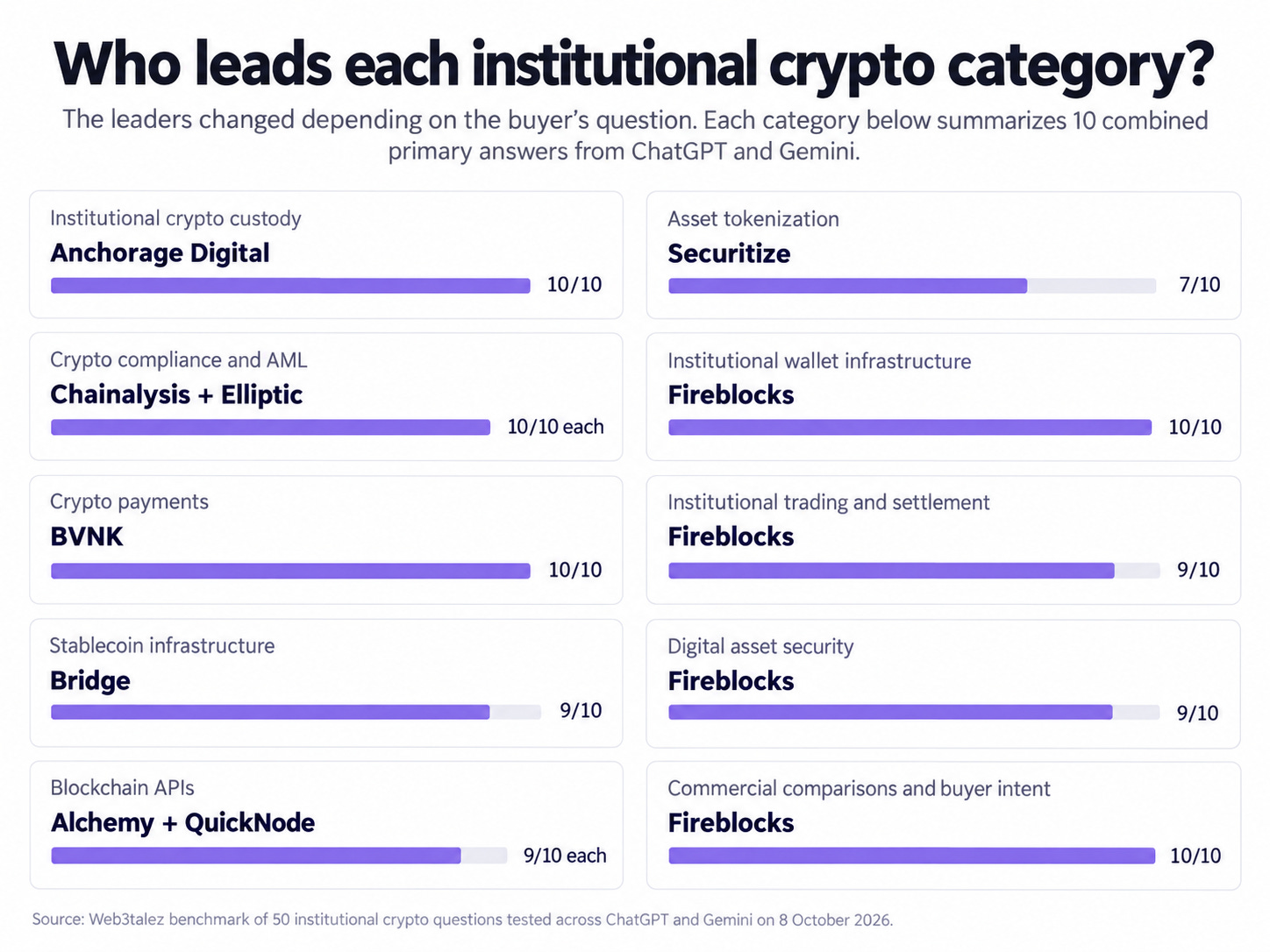
The table below shows the most frequently recommended companies across all 10 categories. Each category had 10 answers from ChatGPT and Gemini combined.
View this chart's data as a table
| Use case | Companies recommended | Frequency |
|---|---|---|
| Institutional crypto custody | Anchorage Digital, Fireblocks, BitGo | 10/10, 9/10, 7/10 |
| Crypto compliance and AML | Chainalysis, Elliptic | 10/10 each |
| Crypto payments | BVNK, Bridge | 10/10, 9/10 |
| Stablecoin infrastructure | Bridge, BVNK, Circle | 9/10, 8/10, 8/10 |
| Blockchain APIs | Alchemy, QuickNode | 9/10 each |
| Asset tokenization | Securitize | 7/10 |
| Institutional wallet infrastructure | Fireblocks | 10/10 |
| Institutional trading and settlement | Fireblocks, Copper | 9/10, 8/10 |
| Digital asset security | Fireblocks | 9/10 |
| Commercial comparisons and buyer intent | Fireblocks | 10/10 |
This suggests that a company doesn’t necessarily need to offer every type of use case to appear frequently in AI answers. Being relevant to a specific use case also matters.
What happens when buyers ask about pricing or alternatives?
The major companies continued to appear when questions focused on pricing, comparing providers, or finding alternatives.
Here’s how four companies performed in questions relevant to their products:
View this chart's data as a table
| Company | Times recommended | Recommendation rate |
|---|---|---|
| Fireblocks | 45 out of 52 | 86.5% |
| Copper | 18 out of 24 | 75.0% |
| Anchorage Digital | 20 out of 40 | 50.0% |
| Circle | 18 out of 42 | 42.9% |
These questions included things like comparing providers, finding cheaper alternatives, and choosing infrastructure for banks or fintechs.
However, the companies weren’t all evaluated against the same questions, so these percentages aren’t a direct head-to-head comparison.
What the results show is that AI recommends these companies even when buyers are exploring their options or preparing to make a purchase.
But when AI recommends a company, whose website does it get its information from?
Which websites does Gemini cite in its answers?
For this part of the research, I focused on Gemini because the ChatGPT results didn’t consistently provide the exact website links behind its citations. Without those links, I couldn’t reliably compare the websites both platforms used.
Of the 50 Gemini answers, 32 contained website links I could analyse. These produced 228 citation records from 83 different webpages.
Here are five websites that appeared frequently:
View this chart's data as a table
| Website | Times cited | Different pages cited |
|---|---|---|
| Openfort | 18 | 3 |
| Alchemy | 11 | 5 |
| Agio Ratings | 11 | 1 |
| Cobo | 9 | 3 |
| Eco | 9 | 2 |
Openfort was cited 18 times, but 14 of those citations came from a single article comparing Fireblocks alternatives, all within one Gemini answer.
This means a website can have several citations simply because AI references different parts of the same article. It doesn’t necessarily mean AI found several independent sources supporting the same information.
Another finding stood out. Only 26 of the 228 citation records could be confidently linked to a recommended company’s own website, covering 10 different pages.
The other citations included competitors’ websites and sources that couldn’t be confidently linked to the companies being recommended. This doesn’t automatically make them independent endorsements.
So, even when AI recommends a company, it may rely on information published by another company or website.
What kinds of pages did Gemini cite?Educational content appeared most often in Gemini’s citations.
Of the 228 citation records:
Educational articles and guides: 91 (40%)
Comparison pages: 32 (14%)
Regulatory and compliance pages: 17 (7%)
Product pages: 12 (5%)
Pricing pages: 10 (4%)
Technical documentation: 5 (2%)
Research reports: 5 (2%)
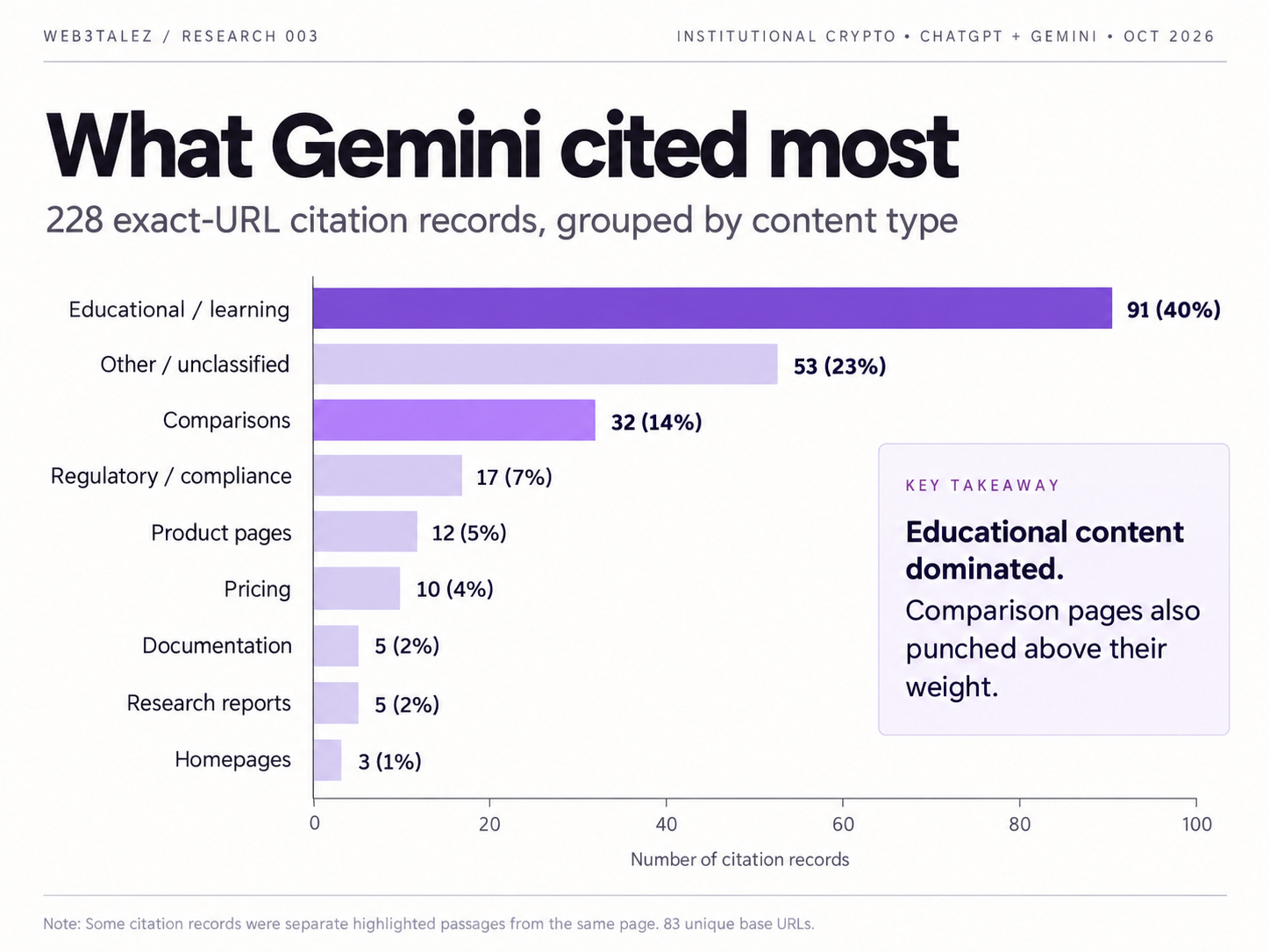
The remaining records came from homepages and other types of content.
One thing worth noting is that 228 citations doesn’t mean 228 different webpages. They came from just 83 pages, including 34 educational pages and six comparison pages. Gemini sometimes referenced different sections of the same article multiple times.
So, while educational content appeared most often, we can’t conclude that Gemini automatically prefers it. The research only shows which pages were cited in this particular experiment.
What are the recommended companies actually publishing?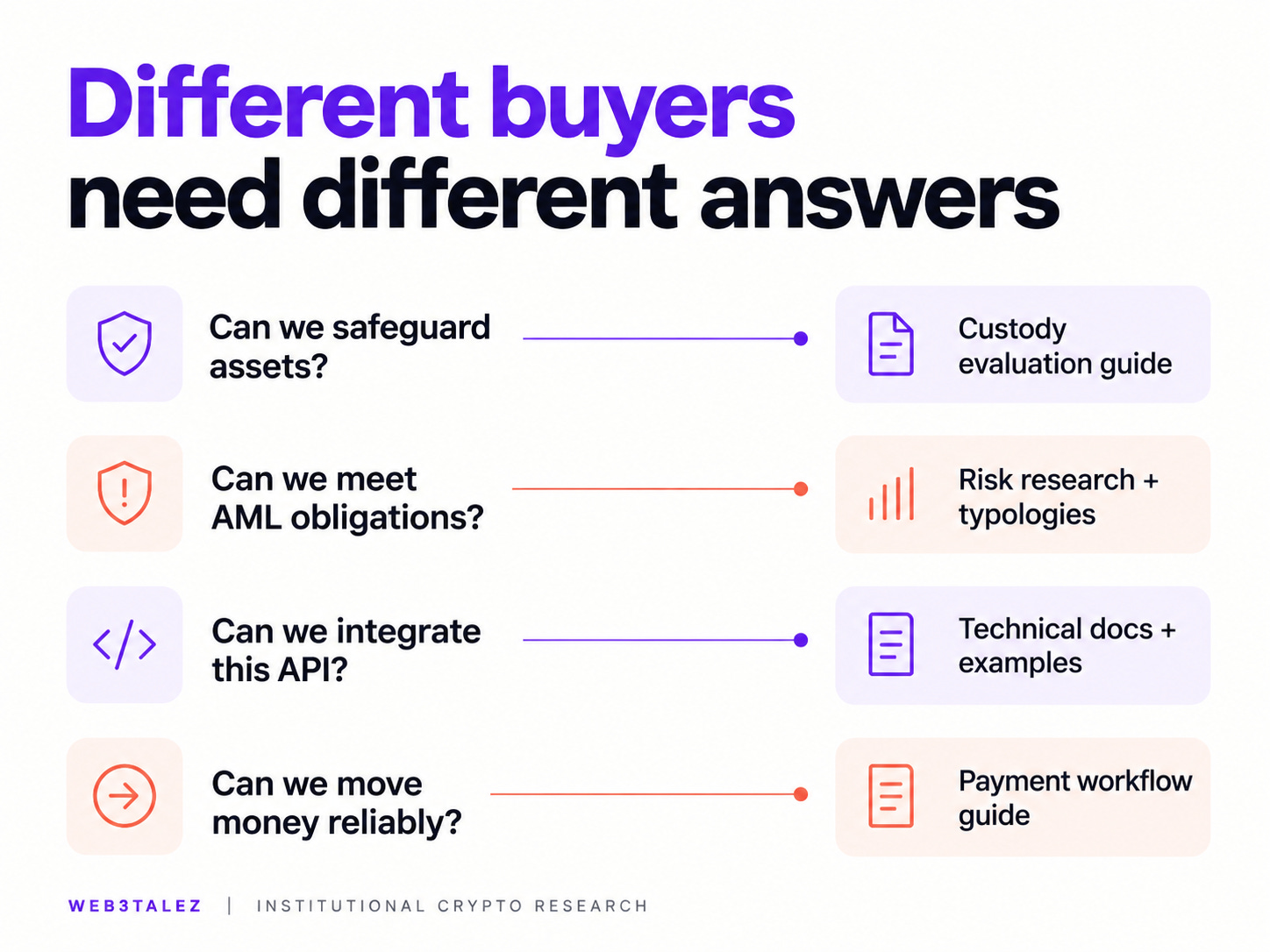
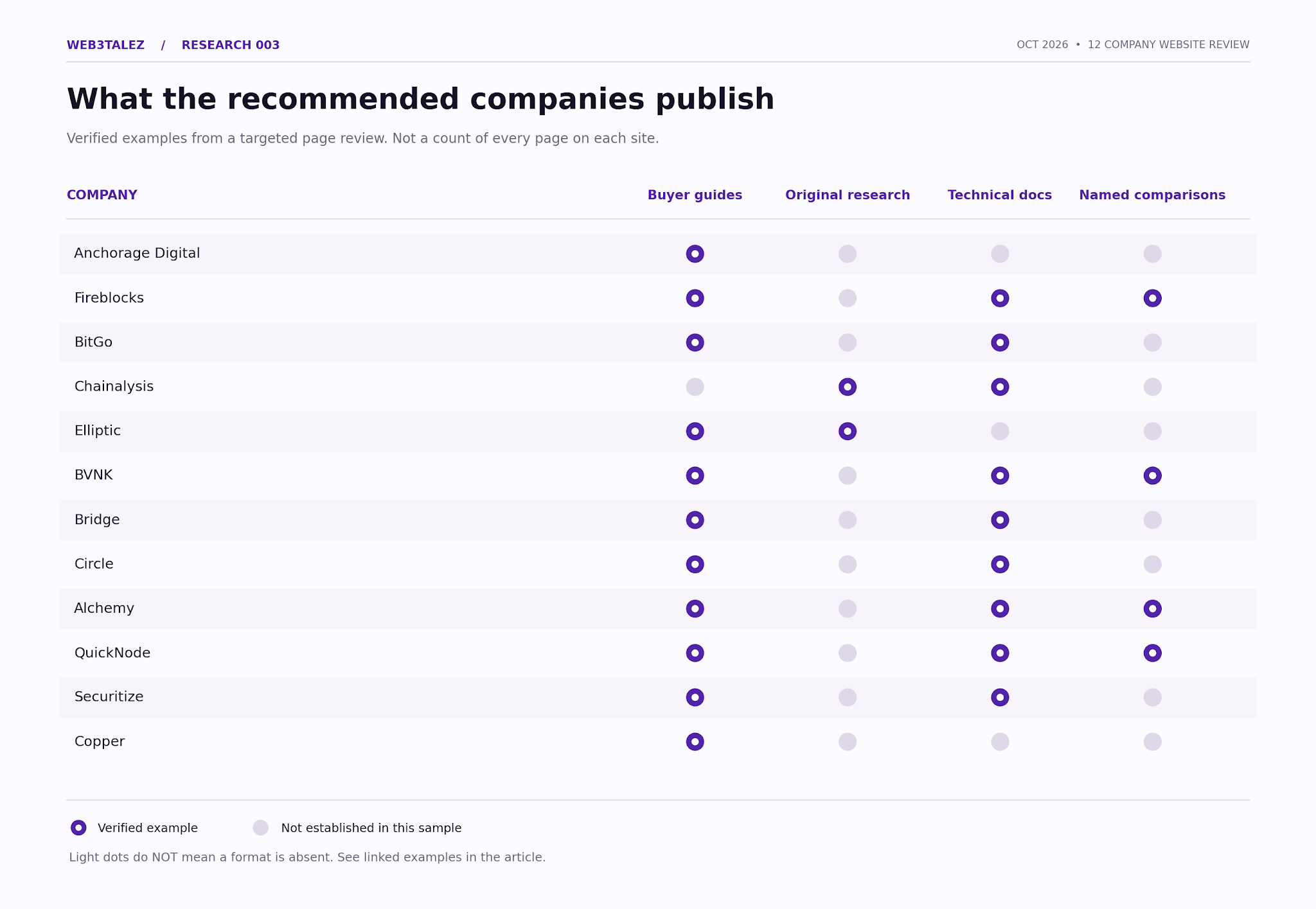
I reviewed the websites of some of the recommended companies looking for buyer guides, original research, technical documentation and named competitor comparisons.
The point was to see how the companies explain decisions to a potential buyer, not to count their total indexed pages.
Custody: Does the content help a bank evaluate risk?
Anchorage Digital’s custodian checklist asks about key generation, storage, segregation, controls and responsibility. BitGo’s custody guide explains self-custody, qualified custody and hybrid models, with a comparison table. Fireblocks’ side-by-side custody comparison names BitGo, Anchorage and Coinbase directly and organizes the choice around custody model, licensing, architecture and asset support. Copper’s ClearLoop page is more focused on keeping collateral moving between venues without abandoning custody arrangements.
Both BitGo and Fireblocks also publish wallet integration documentation and developer API references, respectively. These are all relevant to institutional evaluation, but they frame the decision differently. The matched custody answers did not overwhelmingly favor just one publishing style.
Compliance: What evidence can a risk team work with?
Chainalysis’ 2026 Crypto Crime Report organizes original research around fraud, laundering, ransomware and investigations. Elliptic’s practical guide for financial institutions covers typologies, operational controls and compliance maturity. Elliptic also publishes risk typology analysis.
Chainalysis also publishes a KYT API reference for integration teams. Both companies appeared in all ten compliance answers. That makes original research an interesting recurring characteristic, but it cannot tell us whether publishing reports caused those recommendations. Company reputation, coverage of relevant risks and model familiarity could also matter.
Payments and stablecoins: Does the content explain how money moves?
BVNK’s stablecoin maturity guide helps payment businesses decide between managed and self-managed infrastructure. Its use-case documentation maps industries, currency flows and delivery models. Bridge’s orchestration guide breaks payments into transfers, virtual accounts and routing primitives, with corresponding API quickstarts. Circle’s payments explainer focuses on stablecoin settlement and the larger payment workflow, while its developer hub links products, APIs and examples.
BVNK additionally publishes a named payment-gateway comparison that discusses Stripe/Bridge and other providers. BVNK led the crypto payments answers, while Bridge led the stablecoin infrastructure subset. Their pages overlap, but a fintech asking how to launch payouts is not necessarily asking the same thing as a team evaluating stablecoin issuance or orchestration.
Blockchain APIs: Does a developer have enough information to compare and build?
Alchemy and QuickNode each publish named comparison pages about competing node providers, including performance, features and cost considerations. Both also maintain practical API documentation: Alchemy’s getting-started guide and QuickNode’s SDK quickstart.
Both were recommended in nine of ten API answers. Their publishing approaches have more in common than a simple winner-versus-loser narrative suggests. Comparison-page figures are vendor-authored; readers should test their own workloads rather than treat those pages as independent benchmarks.
Tokenization and trading: Can institutions see the operating workflow?
Securitize’s issuer help center covers offering management, investor workflows, compliance and integrations, with separate issuer API instructions. Securitize appeared in seven of ten tokenization answers. For trading and collateral, Copper’s ClearLoop explanation describes settlement connectivity, counterparty exposure and operational structure. Fireblocks’ custody and trading comparisons cover adjacent decisions from a different angle.
Is there one content format that all the category leaders share?Not one that this review establishes. The audit shows a mix of evaluation guides, original research, API documentation and named comparisons. Below is a matrix of verified examples found in the pages sampled. A light dot means I did not establish that format in this limited review, not that the company has never published one.
First of all, you may need to check out the Crypto Institutional Marketing Playbook to understand specific details on how to sell crypto to institutions.
Based on the companies reviewed, a good starting point is to create content that answers the questions potential customers are already asking. A bank evaluating custody providers has different concerns from a fintech building stablecoin payments or a developer comparing blockchain APIs. Their content needs should reflect those differences.
The research suggests focusing on buyer guides, technical documentation, original research, competitor comparisons and clear product information.
But publishing these pages doesn’t guarantee AI recommendations. Companies should also track how often ChatGPT and Gemini recommend them, whether they appear first, and which websites AI cites when discussing their products.
Most times, comparisons suggest an approach organized around buyer questions, rather than publishing the same general explainer for every category.
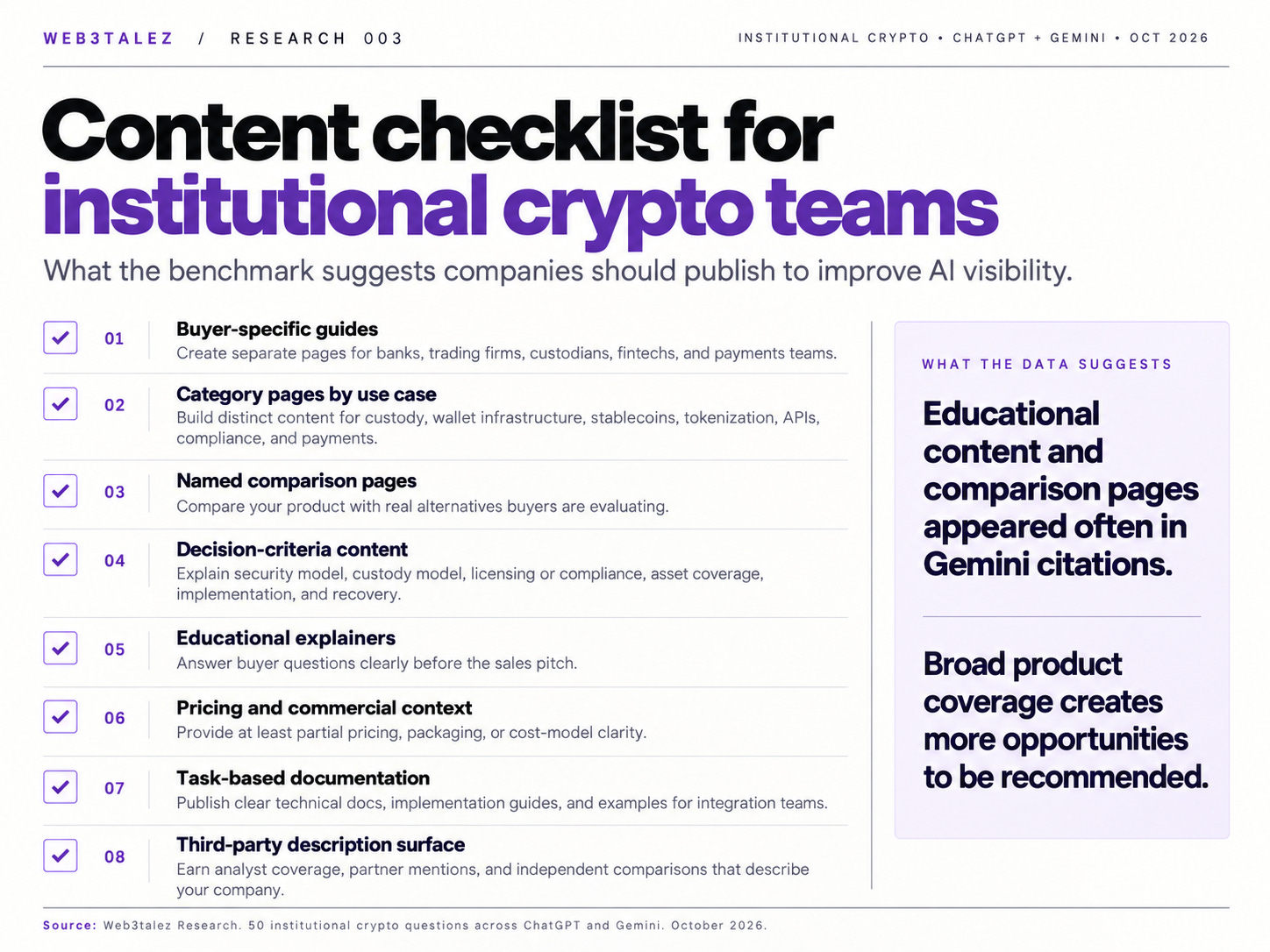
Here are six priorities a content team should have for a crypto firm selling to institutions.
Explain the buyer’s job. Publish guides for the specific teams your product serves, whether that’s banks, custodians, fintechs, developers or payment operators.
Document how the product works. Make security controls, custody or settlement models, integrations, implementation requirements and trade-offs understandable.
Help buyers compare. Use accurate, dated vendor comparisons with meaningful criteria rather than generic feature claims.
Publish evidence. Research, practical explainers, technical examples and customer evidence should answer questions your market asks.
Address commercial details. Explain pricing structures, cost drivers or packaging where disclosure is possible.
Be understandable beyond your own website. Clear positioning and verifiable information make it easier for third parties to describe your product accurately.
So, what do 100 AI answers tell about getting recommended?
Product relevance matters: ChatGPT and Gemini recommended different companies depending on the infrastructure being searched for.
Specialists can compete with larger providers: Companies like Chainalysis, Elliptic, Alchemy and QuickNode performed strongly in their categories.
ChatGPT and Gemini don’t always agree: A company ranked first on one platform may not rank first on the other.
Getting recommended doesn’t guarantee a citation: AI may recommend a company while citing another website.
Educational content and comparisons appeared frequently: These accounted for more than half of Gemini’s captured citation records.
The recommended companies publish content for specific buyers: Their websites include research reports, technical documentation, buyer guides and provider comparisons.
That’s it for my letter to you today . See you in your inbox again soon
Want to reach out?